We are wrapping up our tour through Southeast Asia and about to embark on the next Chapter: Nepal and the Great Himalaya Trail (GHT). The GHT is a proposed trail that will stretch from one end of the Himalaya Mountains to the other. So far only the Nepal and Bhutan sections have been walked, mapped, and documented. The other sections are still being researched. The Nepal section offers a High Trail version and a Low Trail version. The Low Trail crosses through villages and is called "The Cultural Route". The High Trail traverses through the heart of the Himalaya range with an average altitude between 12,000' and 15,000'. The Nepal section was first done over two seasons in 2008-09 by Robin Boustead and his team.
The GHT was first hiked in one season during 2010, involving a combination of the high and low routes. Our focus is on the High Trail, which hasn't yet been completed in one season. A large part of this is weather and conditions permitting, however. Snow conditions will be the biggest factor on whether we attempt the biggest passes of the High Trail. If conditions are too hazardous then we will detour around these areas on the Low Route. When we arrive in Nepal in a week we are going to do a "shakedown" trek to asses conditions at Tillman Pass which is one of the most difficult passes we would cross on the trail.The amount of time it takes to cover the GHT is highly variable. Some of the first expeditions took 120-150 days but in recent years the speed record was set at 49 days. We have talked to some other people that we believe move at a similar pace and figure it should take 9 or 10 weeks. The wild thing about this trail is that it is a trek in and of itself to get to and from the trailhead.
We are fortunate to be joined in this endeavor by two great friends: Molly Eimers and Seth Wolpin. Molly will be joining us from Idaho and Seth from Washington. We know Molly and Seth through trail racing and our ultrarunning community; both have a zest for outdoor pursuits and lead lifestyles of adventure. Seth has most recently been spending a lot of time in Nepal helping lead treks and a stage race in the Everest and Annapurna circuit. He has a lot of contacts over there in relation to this trail and has been the driving force in gathering data on what we are about to attempt. We can't thank him enough for the work he has put into this.To learn more about Molly and Seth, you may visit their blogs at http://missmoeimers.blogspot.com/ and http://www.sethwolpin.com, respectively.
Once we get going communication will be mostly via GPS and SPOT. You may track our GPS coordinates through our team website ("Where Are We?" tab) that should show a map and our last GPS coordinates. SPOT will be posted under "Current Location" on this blog. Bear in mind SPOT coverage is reported to not be that good in Nepal.We also have a satellite phone and an SOS function on our GPS trackers in case there's an emergency. For photos, updates and other ramblings we have created our team facebook page called Great Himalaya Traverse which you are welcome to join.
Finally, as we trek we are raising funds for an organization called Wide Open Vistas which helps improve education and health outcomes for Sherpa children in Nepal. $10 will send a kid to school for a month. Our goal is to try to raise at least $5000. See Wide Open Vistas or visit our team website ("How to help") to learn more about our fundraising campaign and how you can help. Thanks for all your support everyone! We'll be in touch when we can.
Monday, March 24, 2014

Sunday, March 16, 2014
Travels With Dan - Part 2
Hoi An, Vietnam was the next stop in our travels with Dan and turned out to be a foodies paradise. When we first met Dan in Cambodia he was dealing with some stomach issues but that turned around after eating a snake on a stick. Really? If you are feeling under the weather with GI issues why would you eat a snake on a stick? But it seemed to do the trick. Dan was back and ready to go big. He went back the next night and got a bigger snake. By the time we got to Hoi An he was in full gear. It was there that we started to refer to ourselves as "fathletes" or "food athletes".
 Local fishing boat found on run in Hoi An
The entire town of Hoi An is a World Heritage Site and reminded us in some ways as a Vietnamese version of Luang Prabang. The town was clean with tidy buildings, city wide Wifi access, a huge selection of tailors (200+), and the most variety in street food we saw the entire time in SE Asia. At times the food selection and ingestion got completely out of hand. Dan would walk down the street and every food vendor would have something different. If we hadn't had it yet then we would have to get a serving (or 3). Banh Bao or "White Rose"- steamed dumplings with minced shrimp, Hoanh Thanh - wontons, Cau Lau - pork, greens, bean sprouts in broth, potato crust pizza, Ban Mi - a delicious pate (I was told not to ask) sandwich with several layers of vegetable and sauce in it, fresh fruits, grilled corn, plain and coconut filled donuts, custard apple shakes, rice pudding, sweet potato cakes, and another dozen delicious treats that all blurred together into a crazy food orgy. Every time Dan said "I'm so full!" we would turn around and he was ordering something else.
 Sweet potato and coconut vendor
 Peanut pastry vendor
 Our favorite chef in Hoi An
If you want easy living and great food then schedule a big chunk of time for Hoi An if you visit Vietnam.
 Hoi An riverside
From Hoi An we went to Hong Doi to visit some of the biggest caves in the world. We visited Paradise Cave which was so large that it was hard to get perspective within some of the caverns and Phong Nha Cave which you take a boat up a river and then into the cave.
 Entering Phong Nha Cave
 Looking out entrance to Phong Nha Cave
I have been in a number of caves over the years spelunking and these were some of the most impressive I have ever seen, especially when it comes to the size of the caverns. Paradise Cave goes another 30km (18.5 miles) deeper into the mountain then we were allowed to go. The town of Hong Doi blew. Of any place in the world I have been there is a gross disproportion of hotel rooms to restaurants. Every other building was a musty dilapidated hotel (often run by the government) but there were almost no restaurants and the few that existed were not set up for tourists. None of the menus were in English so this was the one place the entire trip that I would randomly pick something on the menu and hope to hell that I wasn't getting dog, bat, some sort of head floating in broth, or animal entrails. Kathleen and I seemed to get lucky though we didn't always finish everything on our plates. Dan didn't eat much. It was a weird town and we were happy to leave and don't think we picked up any bedbugs while we were there.
Our next stop was Hanoi. Kathleen and I ended up not liking it that much and found Saigon to be the better of the two "big cities". Many travelers though say the opposite since Hanoi has so much history but at least the time of year that we were there it was constantly grey, wet, and drizzly. The weather was way too reminiscent of Seattle but without the ocean or mountains to make it worthwhile. It was just a large dreary city. We did see some of the museums there and were subjected to some pretty outrageous propaganda like a militia woman taking out 5 American tanks with her knife and how the militia would shoot B-52s down with their rifles (B-52s fly almost 10x as high as an AK-47 can shoot). It was still interesting though to see the Vietnamese perspective of the war.
 Army Museum, Hanoi
From Hanoi we went to Halong Bay which is a natural World Heritage Site. It is an area of 3000+ limestone islets that just up out of the Gulf of Tonkin. The rock kharsts are draped with thick vegetation and this is probably one of the most photographed landscapes in Vietnam. We ended up booking a tour that had us sleep on a boat in the bay for 2 nights. In hindsight I would have done it how I had initially thought and traveled to Cat Ba Island and then toured Lan Ha Bay instead. This has similar topography but is less visited. Halong Bay is a bit overrun and the tour didn't provide the amount of kayaking that I had hoped. We toured a scenic but commercial cave on one of the islands, spent a little time kayaking (but nowhere near enough),
 Kayaking the kharsts
hiked up to a very rusty unstable lookout that had a great view over Cat Ba island,
 Lookout tower on verge of collapse
 View from top of Ngu Lam
and spent some time exploring Cat Ba town. We did meet nice people on the boat. 2 Argentines (Ezekial and Thomas), another American (Bill), an older German man and his daughter who teaches in Vietnam, 3 Brits, 2 German girls from Frankfurt, a Frenchmen who seemed like a gypsy and kept us entertained with magic tricks, and a party of Israelis. It was an entertaining group to hang out and drink with.
 Halong Bay, Vietnam
 Halong Bay, Vietnam
 Halong Bay, Vietnam
 Halong Bay, Vietnam
 Halong Bay, Vietnam
Right after getting back to Hanoi Dan got really sick. We suspect a Ban Mi sandwich (like I said before we were told not to ask about the "pate"). We had all been eating the same meals except for that. When Dan got to Hanoi that first night he was losing fluids from both ends and became very dehydrated to the point that we took him to the hospital. Turns out that the Hanoi ER was only 2 blocks from our hospital. It appeared to be a teaching hospital because the "doctors" that came and talked to him looked to be about 12 years old but there was always one older guy standing in the background watching and listening to what was going on. They wrote him a prescription for an oral electrolyte solution and told him that he needed to go to the "foreigner hospital". This was a French run hospital (L'hospital Francais de Hanoi) that involved a cab ride to get there. They recommended that he be admitted overnight for fluid resuscitation but he declined that and only elected to get a quick bolus of IV fluids over a 2 hour period. We hung out for an extra day to see if Dan would recover but he felt so spent and drained from being sick that he elected to fly home instead of going to Sapa with us. After a fun 5 weeks of traveling together we said our good byes. We had enough fun and Dan has a big enough travel bug that we feel pretty strongly that we have not seen the last of him on our world tour.
Sapa was our last stop in Vietnam and it turned out to be one of our favorite spots we found in SE Asia. As is typical we usually find the best guesthouse, restaurant, trail, or town just at the end of our time in that area. Sapa is a old French hill station in Northwest Vietnam. It is only 9 km as a crow flies to the summit of Fansipan which is the highest mountain in Indochina but many people take 2 nights to trek it. The area is surrounded by Hmong hill tribe villages and is laced with trails. We spent 5 days here exploring the lower trails of Fansipan, going a little further into the mountains each time as we figured out the trail network. I had a rough map but there are no trail signs. The paths have been used by the hill tribes for centuries and are a maze. Some go to the next village but some just go to fields or fade out in the jungle.
 Cat Cat Waterfall, Sapa
 Below Sapa
We also rented a motorcycle one day to venture further out into the scenic and rugged mountains in the area.
 Perfect road for biking
Being high up in the mountains it was frequently socked in by fog. This was some of the thickest fog I have been in. The only other time like that was when I was sailing to Greenland with my Dad and the fog off Nova Scotia was so thick that I could barely see the front of the boat 36 feet away. This was like that where seeing across the street was difficult at times. Watching the hill tribe women fading in and out of the mist was like being in another world.
 Hmong tribeswomen
It also made crossing the street dangerous as motorcycles popped out of nowhere. If we ever go back to Vietnam for a month the plan would be to do one week in Halong Bay (or actually Lan Ha Bay south of it) and then 3 weeks in Sapa. The only reason we left Sapa when we did was that our visa expired so we had to leave Vietnam.
We are now back in Thailand on the island of Ko Chang. Our accommodation is bungalow built into the trees (treehouse) on a steep hillside with the ocean surf breaking below our porch. We plan on spending 2 weeks here just resting up and soaking in the sun and sea before heading to Nepal and the Great Himalaya Trail.
Local fishing boat found on run in Hoi AnThe entire town of Hoi An is a World Heritage Site and reminded us in some ways as a Vietnamese version of Luang Prabang. The town was clean with tidy buildings, city wide Wifi access, a huge selection of tailors (200+), and the most variety in street food we saw the entire time in SE Asia. At times the food selection and ingestion got completely out of hand. Dan would walk down the street and every food vendor would have something different. If we hadn't had it yet then we would have to get a serving (or 3). Banh Bao or "White Rose"- steamed dumplings with minced shrimp, Hoanh Thanh - wontons, Cau Lau - pork, greens, bean sprouts in broth, potato crust pizza, Ban Mi - a delicious pate (I was told not to ask) sandwich with several layers of vegetable and sauce in it, fresh fruits, grilled corn, plain and coconut filled donuts, custard apple shakes, rice pudding, sweet potato cakes, and another dozen delicious treats that all blurred together into a crazy food orgy. Every time Dan said "I'm so full!" we would turn around and he was ordering something else.
Sweet potato and coconut vendorPeanut pastry vendor
It was very affordable. Pretty much all the food was 20,000 dong ($1) per serving and draft beer in the neighborhood of our hotel was 3000 dong (15 cents) to wash it all down. We found one little stand/restaurant in the market that we would go back to several times a day. The lady who ran it started to love us so much that she would run over whenever she would spot us, shake our hands, and push people out of the way to make room on the bench in front of her stall. She would then encourage us to sing her praises every time a Westerner walked by. Between what we spent there over 3 days and the business we recruited for her she and her husband probably were able to take the rest of the month off. Our favorite chef in Hoi AnIf you want easy living and great food then schedule a big chunk of time for Hoi An if you visit Vietnam.
Hoi An riverside From Hoi An we went to Hong Doi to visit some of the biggest caves in the world. We visited Paradise Cave which was so large that it was hard to get perspective within some of the caverns and Phong Nha Cave which you take a boat up a river and then into the cave.
Entering Phong Nha Cave Looking out entrance to Phong Nha CaveI have been in a number of caves over the years spelunking and these were some of the most impressive I have ever seen, especially when it comes to the size of the caverns. Paradise Cave goes another 30km (18.5 miles) deeper into the mountain then we were allowed to go. The town of Hong Doi blew. Of any place in the world I have been there is a gross disproportion of hotel rooms to restaurants. Every other building was a musty dilapidated hotel (often run by the government) but there were almost no restaurants and the few that existed were not set up for tourists. None of the menus were in English so this was the one place the entire trip that I would randomly pick something on the menu and hope to hell that I wasn't getting dog, bat, some sort of head floating in broth, or animal entrails. Kathleen and I seemed to get lucky though we didn't always finish everything on our plates. Dan didn't eat much. It was a weird town and we were happy to leave and don't think we picked up any bedbugs while we were there.
Our next stop was Hanoi. Kathleen and I ended up not liking it that much and found Saigon to be the better of the two "big cities". Many travelers though say the opposite since Hanoi has so much history but at least the time of year that we were there it was constantly grey, wet, and drizzly. The weather was way too reminiscent of Seattle but without the ocean or mountains to make it worthwhile. It was just a large dreary city. We did see some of the museums there and were subjected to some pretty outrageous propaganda like a militia woman taking out 5 American tanks with her knife and how the militia would shoot B-52s down with their rifles (B-52s fly almost 10x as high as an AK-47 can shoot). It was still interesting though to see the Vietnamese perspective of the war.
Army Museum, HanoiFrom Hanoi we went to Halong Bay which is a natural World Heritage Site. It is an area of 3000+ limestone islets that just up out of the Gulf of Tonkin. The rock kharsts are draped with thick vegetation and this is probably one of the most photographed landscapes in Vietnam. We ended up booking a tour that had us sleep on a boat in the bay for 2 nights. In hindsight I would have done it how I had initially thought and traveled to Cat Ba Island and then toured Lan Ha Bay instead. This has similar topography but is less visited. Halong Bay is a bit overrun and the tour didn't provide the amount of kayaking that I had hoped. We toured a scenic but commercial cave on one of the islands, spent a little time kayaking (but nowhere near enough),
Kayaking the kharsts hiked up to a very rusty unstable lookout that had a great view over Cat Ba island,
Lookout tower on verge of collapseView from top of Ngu Lam and spent some time exploring Cat Ba town. We did meet nice people on the boat. 2 Argentines (Ezekial and Thomas), another American (Bill), an older German man and his daughter who teaches in Vietnam, 3 Brits, 2 German girls from Frankfurt, a Frenchmen who seemed like a gypsy and kept us entertained with magic tricks, and a party of Israelis. It was an entertaining group to hang out and drink with.
Halong Bay, VietnamHalong Bay, VietnamHalong Bay, VietnamHalong Bay, VietnamHalong Bay, VietnamRight after getting back to Hanoi Dan got really sick. We suspect a Ban Mi sandwich (like I said before we were told not to ask about the "pate"). We had all been eating the same meals except for that. When Dan got to Hanoi that first night he was losing fluids from both ends and became very dehydrated to the point that we took him to the hospital. Turns out that the Hanoi ER was only 2 blocks from our hospital. It appeared to be a teaching hospital because the "doctors" that came and talked to him looked to be about 12 years old but there was always one older guy standing in the background watching and listening to what was going on. They wrote him a prescription for an oral electrolyte solution and told him that he needed to go to the "foreigner hospital". This was a French run hospital (L'hospital Francais de Hanoi) that involved a cab ride to get there. They recommended that he be admitted overnight for fluid resuscitation but he declined that and only elected to get a quick bolus of IV fluids over a 2 hour period. We hung out for an extra day to see if Dan would recover but he felt so spent and drained from being sick that he elected to fly home instead of going to Sapa with us. After a fun 5 weeks of traveling together we said our good byes. We had enough fun and Dan has a big enough travel bug that we feel pretty strongly that we have not seen the last of him on our world tour.
Sapa was our last stop in Vietnam and it turned out to be one of our favorite spots we found in SE Asia. As is typical we usually find the best guesthouse, restaurant, trail, or town just at the end of our time in that area. Sapa is a old French hill station in Northwest Vietnam. It is only 9 km as a crow flies to the summit of Fansipan which is the highest mountain in Indochina but many people take 2 nights to trek it. The area is surrounded by Hmong hill tribe villages and is laced with trails. We spent 5 days here exploring the lower trails of Fansipan, going a little further into the mountains each time as we figured out the trail network. I had a rough map but there are no trail signs. The paths have been used by the hill tribes for centuries and are a maze. Some go to the next village but some just go to fields or fade out in the jungle.
Cat Cat Waterfall, SapaBelow Sapa We also rented a motorcycle one day to venture further out into the scenic and rugged mountains in the area.
Perfect road for biking Being high up in the mountains it was frequently socked in by fog. This was some of the thickest fog I have been in. The only other time like that was when I was sailing to Greenland with my Dad and the fog off Nova Scotia was so thick that I could barely see the front of the boat 36 feet away. This was like that where seeing across the street was difficult at times. Watching the hill tribe women fading in and out of the mist was like being in another world.
Hmong tribeswomenIt also made crossing the street dangerous as motorcycles popped out of nowhere. If we ever go back to Vietnam for a month the plan would be to do one week in Halong Bay (or actually Lan Ha Bay south of it) and then 3 weeks in Sapa. The only reason we left Sapa when we did was that our visa expired so we had to leave Vietnam.
We are now back in Thailand on the island of Ko Chang. Our accommodation is bungalow built into the trees (treehouse) on a steep hillside with the ocean surf breaking below our porch. We plan on spending 2 weeks here just resting up and soaking in the sun and sea before heading to Nepal and the Great Himalaya Trail.
Tuesday, March 4, 2014
Steinbeck had "Travels With Charlie", we have "Travels With Dan"
After our volunteer time at Care For Dogs Foundation we went and spent a week relaxing in Pai, Thailand with the plan on meeting Dan Sears in Phnom Penh on 3 Feb. A combination of late planning on buying a bus ticket and the Thai elections made us end up doing the trip between the two towns in one long push instead of two. It was a 42 hour marathon consisting of mini bus-bus-tuktuk-taxi-bus-walk (across the border)-short bus-bus-bus. It was the one time since we had left Koh Samui we had reservations at a hotel and we didn't arrive until 7am. The reservation was non-refundable so we checked into our room for the last 5 hours in order to take a shower and nap. I hope we don't repeat such a journey any time soon. It takes days to recover from something like that. The good planning with poor execution continued when we discovered that the Vietnamese embassy was closed for the week due to the Tet New Year. Instead of spending a few days in Phnom Penh and then going to Siem Reap and Angor Wat we decided to flip flop the plan. This meant getting back on a bus and back tracking 7 hours to where we had just been.
Angkor
had been on our hit list of sights to see for a long time. It is one
of the archaeological wonders of the world. Because of this Siem Reap
is a bit of a zoo. Over 2 million visitors come here each year and
the temples can be quite crowded at times. Luckily we had been given
the insiders guide to seeing Angkor by Trevor Ranges who wrote the
National Geographic guide to Cambodia. I knew his sister in high
school so she facilitated the connection. Trevor gave us an
itinerary of when and where to be in the huge complex of temples to
best avoid the crowds and his plan worked perfectly. We spent 3 days
exploring and got some great shots without crowds of people. We were
able to take pictures with no one in them but then going by the temple
an hour later there would be several hundred people milling around.
It very much enriched our experience there.
 Sunrise Angkor Wat
  Sunrise Bayon Temple, Angkor
 Angkor Wat
  Inner courtyard, Angkor Wat
  Ta Prohm Temple, Angkor
  Victory Gate, Angkor Thom
  Pre Rup Temple, Angkor
It was here that we became friends with Fanny who was
traveling by herself. She joined us for one of the days at Angkor
and also went with us to Phare, the Cambodian Circus which was a
Cirque du Soleil type experience. The circus provides a means of
education for disadvantaged youth in both traditional education and
the arts. It has helped many a young Cambodian over the years be
able to learn skills to better their lives and to travel the world.
It was a very entertaining show that supported a good cause.
The strangest part of the exploring Angkor Wat was when we had just made an incense offering to a Buddha. We stepped outside and seconds later we hear a loud thunk. We look up to see a pigeon rolling down the temple stairs making loud thwacks every step that it hits. We looked at each other like WTF!!! We make an offering and now birds are dropping dead out of the sky. A security guard watched this all occur also and went to examine the bird. Looking at the carcass is was obvious that the bird had been dead for some time and must have been dropped by another bird. Freaked us out for a couple of minutes until we realized this.
 Dead bird omen
Then
it was back to Phnom Penh. If we never travel this road in a bus
again that would be fine by us. In Phnom Penh we were worried that
getting our Vietnam visas from a communist embassy was going to be an
exercise in patience with visions of a nightmare DMV in our heads.
We expected a crowded lobby, long lines, and crabby workers. Turns
out the DMV could learn some lessons from the communists. The
process was super quick and efficient. We dropped our paperwork off
and were done within 10 minutes and told to come back the next
morning to pick them up. Pick up the next day took all of 2 minutes.
That gave us the rest of the day to explore the Toul Sleng S21
prison and the Choeung Ek Killing Fields. Two places where some of
the worst crimes of the Kymer Rouge genocide occurred. It was a
sobering and depressing place to visit and contemplate how horrible
humans can be to each other. In the 3 1/2 years that the Khmer Rouge
ruled almost 1 in 4 Cambodians died from disease, starvation,
overwork, or outright execution ending only when the Vietnamese
invaded and occupied the country.
 View from inside Toul Sleng prison
After that kind of day we needed
some alcohol so we met up with Fanny again and went out and
celebrated Dan's birthday (which had officially been the day before).
We found a rooftop bar and had multiple rounds of brightly colored
fruity cocktails. It was good to end the day on a lighter note.
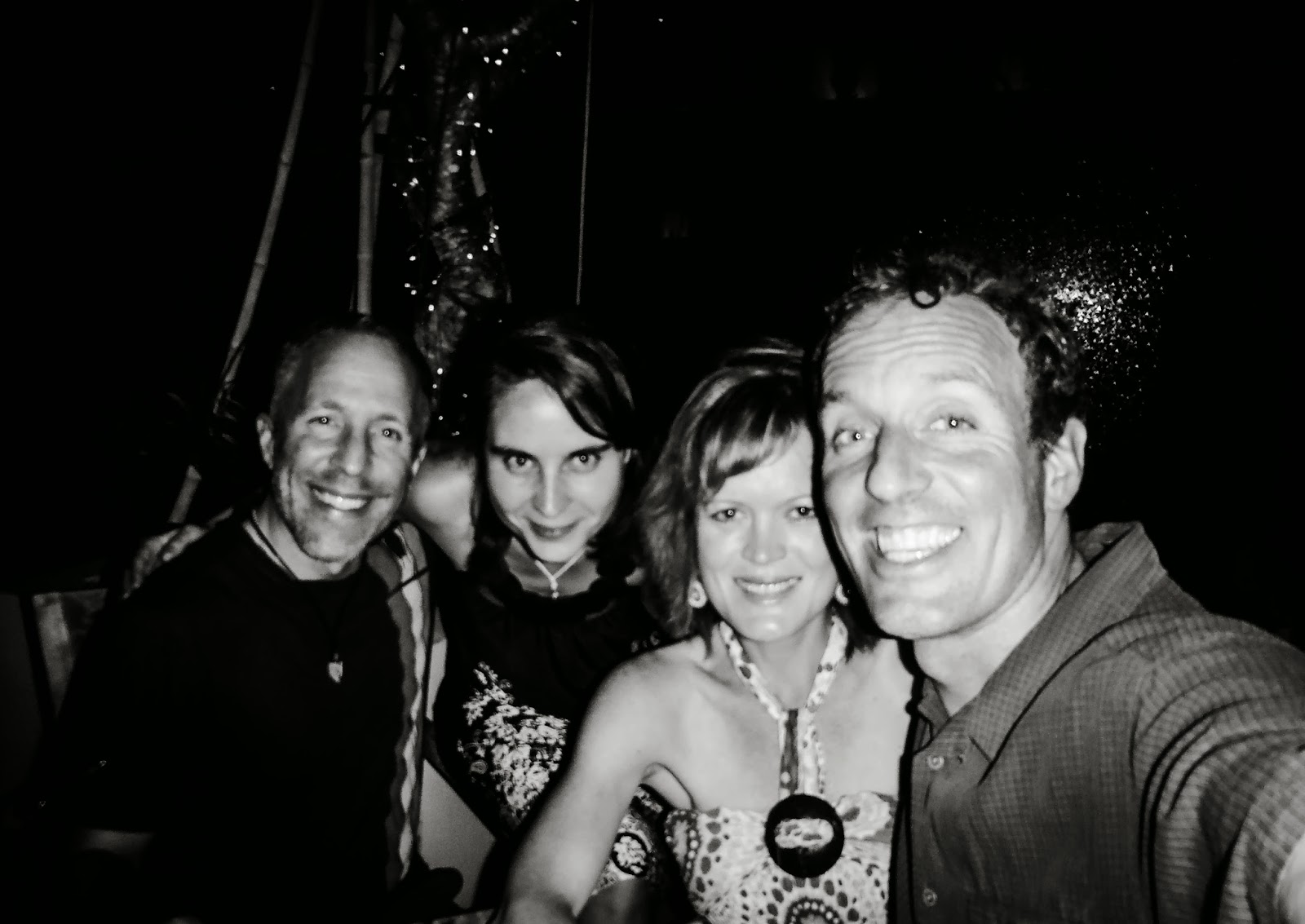 Celebrating with the birthday boy
From
there it was on to Vietnam and Ho Chi Minh City (Saigon). This may
be one of the most chaotic places I have ever visited. Bangkok was
bumper to bumper cars with tuktuks and motorcycles in between. Saigon
is a massive river like flow of motorcycles all cutting in between
each other in all directions. We were glad that we had been
practicing crossing the street in SE Asia for the last few months
because you literally risked your life every time you stepped off the
sidewalk. Even on the sidewalk you were at risk as they used that as
path to go the wrong way down one way streets. I got to where I
would raise my hands and shout "I'm alive!" every time we
successfully made it across a major road.
 Rivers of motorcycles
Saigon is one of those
cities where you either embrace it or hate it. We all chose to
embrace it and ended up enjoying it much more then we had initially
expected. On one of the days Kathleen and I went out to the Chu Chi
Tunnel complex where the Vietcong lived underground in tiny tunnels
during the war just outside the city. Huge battles and heavy bombing
occurred here to try to control this area. Our tour guide at the
complex turned out to be a former Viet Cong who still has a defect in
his upper arm where an M60 machine gun bullet hit him from a
helicopter. Listening to his stories you could tell he was very
proud of his service and what the Vietnamese had done to repel the
"colonial invader" to gain their independence. Yet at the
same time he very much felt that bygones should be bygones and that
"Vietnam should have more friends. When you have more friends
then you have less enemies". I have met many American Vietnam
vets but this was the first person I had ever met that saw things
from the other perspective.
 Crawling through one of the Chu Chi Tunnels
 Former Vietcong tour guide Doung
We also toured the War Remnants Museum
which used to be called the Museum of American War Crimes. Once the
US had reestablished diplomatic contact with Vietnam they toned down
the name but it is still full of a lot of anti-American propaganda.
No matter what your thoughts are about the Vietnam conflict it is
worth a visit here to see the Vietnamese perspective. To this day
there is still unexploded ordinance causing problems and the effects
of Agent Orange and the dioxin we sprayed here continue to cause
neurological disease and birth defects.
Dan
has to eventually get back to the states for work so had more limited
time. Because of this we skipped going to the Mekong Delta south of
Saigon and hopped a plane up to Hue which is near the old DMZ
(Demilitarized Zone) that marks the separation of South from North
Vietnam. It is the old Imperial capital and has a large citadel
where the emperor used to live. This was the site of a large month
long battle during the Tet Offensive during the Vietnam War which
damaged much of the ruins. The Vietnamese are currently rebuilding
some of these structures.
 Citadel outer wall and moat, Hue
  Citadel flag tower
It
was in Hue that we heard the tragic news that our friend Chad
Kellogg had lost his life on Valentine's Day in a climbing accident in Argentina while rappelling down a
mountain called Fitz Roy. We had last seen Chad at our wedding in
November and had been invited to go live with him for the winter in
El Chalten, Argenitina but plane tickets had been cost prohibitive.
Chad was also one of the few people that we had seen during the trying
days of summer when Kathleen's Dad was sick. We are very thankful that we were able to
spend a week with him and his girlfriend Mandy in Thailand – sea
kayaking out to small islands, chilling on the beach, eating good
food, dancing at the wedding, and just enjoying each others company. Chad was an inspiration and dear friend to many. It is a loss that will never be replaced in our lives and one that we are still coming to grips with. He will be missed, but the memories live on.
 Sending a candle down the river for Chad and Mandy
  Kathleen and I kayaking with Chad, Mandy, and Krissy before the wedding
Part 2 of travels with Dan will cover the food orgy in Hoi An, exploring caves in the central highlands, Hanoi, and kayaking Halong Bay. Stay tuned.
Wednesday, January 29, 2014
"Who Let The Dogs Out?"
CARE FOR DOGS FOUNDATION WEEK
Kathleen's Week:
Sweat was streaming down my forehead. The sun was at the hottest point in the afternoon as we moved into position on opposite sides of the field moving slowly and stealthily. We did not have to wait long until we heard the Pfft-plunk sound of Khun Chai's blowdart going off followed by a quick yelp of the dog as it took off into the underbrush with a tranquilizer dart dangling out of its thigh. The trick at this point was to follow the dog but not to scare it in the process. Adrenaline causes the tranquilizer to not work as quickly but if the dog runs away too far before succumbing to the sedation it will not likely be captured. In this case the dog disappeared into some deep underbrush. As I traversed around the edge of the thicket I could see and hear brush rustling and moving. I expected a dog to come charging out at any moment but it turned out to be Maggie, one of the local residents, and a dedicated dog lover. She was smothered in leaves and covered with scratches and cuts all over her arms and shoulders. We filled the truck and returned to the shelter. In an afternoon of darting dogs we managed to catch 3 grown dogs and 2 puppies. One dog had a large laceration across its nose and the two puppies had such a heavy tick burden that they were anemic as a result. Blow darting isn't the first capturing method of choice, but in circumstances where the dogs are skittish and difficult to catch, it's the only way. The dogs were treated, vaccinated and sterilized; and after 1 week of recovery, they were released. This is how my week began.
Chiang Mai is the second largest city in Thailand and is estimated to have 60,000 stray dogs wandering the streets (Bangkok is estimated to have 300,000). Many are dumped at Buddhist temples where the monks won't turn them away but have limited capacity to care for them, some are beaten to death or poisoned, and some end up in the dog meat trade. The dog meat trade is perhaps the most frightening. Strays are rounded up and shipped to Vietnam, often multiple dogs in the same crate where many die en route. The ones that survive are then force tube fed to fatten up and then are boiled alive as there is a belief that the adrenaline tenderizes the meat and has beneficial effects when eaten. (www.tradeofshame.org for more information and a video - viewer discretion strongly advised).
Care For Dogs Foundation (CFD) is where we spent a week helping out where we could. Their primary goal is to control the dog population in the most humane way possible via sterilization programs. This organization is doing a good job under tough conditions. Out of the several dog shelters we have toured they have the nicest and cleanest facility and their dogs appear to be in the best health. Their shelter sterilizations operate out of one small operating suite and their medical team compromises one full time vet and a 50% part-time vet; and whenever possible, international vet volunteers. Other volunteers fill their days by assisting with medical bathing, walking and socializing the dogs which is a huge help. Like all shelters in Thailand they are at maximum capacity or even over it.
Last year CFD accomplished 635 spay/neuter sterilizations. The goal is to expand to 1000 this year. With the current surgical suite and the requisite in-house space it will be hard to reach that goal. That is where I was able to help. I spent the bulk of the week using my former grant writing skills from the University of Washington to apply for a grant from Worldwide Veterinary Service (WVS) seeking funding for the design, orientation, implementation and start-up of a mobile veterinary clinic that would primarily function as a sterilization unit; but would also double as an aide vehicle for community outreach in times during disaster (floods or Tsunami) or crisis (dog meat trade). Naturally, the WVS grant application process is competitive, so irregardless of the announcement, I hope someday this concept can be realized. It's a shame to see such passion and dedication restrained by resources.
John's Week:
I spent the week spaying/neutering and helping out with some of the other sick and injured dogs. It was fun doing surgeries all day (yes vet friends, I did just call surgery fun) though my lower back would be screaming by the end of the day.
In the US I juggle what needs to be done (ideally) with what owners can afford. Here it was balancing what needed to be done with what was available for diagnostics, medications, and equipment. I realized how spoiled I have gotten over the years with pretty much everything I needed available. The hospitals I have worked at have MRI's and CT scanners. Now I was reduced a lot of the time to history, signalment, physical exam, and best guess. No imaging was available and just some very basic blood work. A blood parasite called Ehrlichia is rampant so low platelets are almost "normal" here which helped make some of the surgeries a little more exciting. A lot of the time I had help from a volunteer vet from Russia but there were times I would pre-med, induce, prep, do surgery, and monitor the anesthesia all by myself. Not like the small army of vet nurses I have helping me at home. For those of you that know Monty Python, all I really wanted was the machine that goes "ping". Any type of device that beeped to tell me the heart was beating (pulse ox, EKG, doppler, etc). Instead it was more just watching the chest to see if breathes were being taken. The week showed me that at some level all the fancy gadgets are not necessary (but they sure are nice).
Besides the surgery it was interesting to see some types of cases that I had never seen before. I had seen pictures of Transmissible Venereal Tumors (TVT) before but was now able to help treat some cases. This is a strange type of cancer that is actually contagious and is treated with chemotherapy.
I also saw a case of Trypanosoma which does not exist in North America and is the same type of parasite that causes African Sleeping Sickness in humans. The other success case was a dog whose history and physical exam was classic for Myasthenia Gravis - a disease that causes the the neurotransmitter between the nerves and muscle to not function properly which causes them to get weak after a short bout of exercise. To my surprise Care For Dogs just happened to have had a donation of the drug that treats this problem and the dog responded wonderfully.
It was a great week working with some amazing dedicated people trying to make a dent into a huge problem. We are hoping that this will not be the last time we cross paths with these folks. www.Carefordogs.org to see more on the excellent work they do and how to help out.
Kathleen's Week:
Sweat was streaming down my forehead. The sun was at the hottest point in the afternoon as we moved into position on opposite sides of the field moving slowly and stealthily. We did not have to wait long until we heard the Pfft-plunk sound of Khun Chai's blowdart going off followed by a quick yelp of the dog as it took off into the underbrush with a tranquilizer dart dangling out of its thigh. The trick at this point was to follow the dog but not to scare it in the process. Adrenaline causes the tranquilizer to not work as quickly but if the dog runs away too far before succumbing to the sedation it will not likely be captured. In this case the dog disappeared into some deep underbrush. As I traversed around the edge of the thicket I could see and hear brush rustling and moving. I expected a dog to come charging out at any moment but it turned out to be Maggie, one of the local residents, and a dedicated dog lover. She was smothered in leaves and covered with scratches and cuts all over her arms and shoulders. We filled the truck and returned to the shelter. In an afternoon of darting dogs we managed to catch 3 grown dogs and 2 puppies. One dog had a large laceration across its nose and the two puppies had such a heavy tick burden that they were anemic as a result. Blow darting isn't the first capturing method of choice, but in circumstances where the dogs are skittish and difficult to catch, it's the only way. The dogs were treated, vaccinated and sterilized; and after 1 week of recovery, they were released. This is how my week began.
Chiang Mai is the second largest city in Thailand and is estimated to have 60,000 stray dogs wandering the streets (Bangkok is estimated to have 300,000). Many are dumped at Buddhist temples where the monks won't turn them away but have limited capacity to care for them, some are beaten to death or poisoned, and some end up in the dog meat trade. The dog meat trade is perhaps the most frightening. Strays are rounded up and shipped to Vietnam, often multiple dogs in the same crate where many die en route. The ones that survive are then force tube fed to fatten up and then are boiled alive as there is a belief that the adrenaline tenderizes the meat and has beneficial effects when eaten. (www.tradeofshame.org for more information and a video - viewer discretion strongly advised).
Care For Dogs Foundation (CFD) is where we spent a week helping out where we could. Their primary goal is to control the dog population in the most humane way possible via sterilization programs. This organization is doing a good job under tough conditions. Out of the several dog shelters we have toured they have the nicest and cleanest facility and their dogs appear to be in the best health. Their shelter sterilizations operate out of one small operating suite and their medical team compromises one full time vet and a 50% part-time vet; and whenever possible, international vet volunteers. Other volunteers fill their days by assisting with medical bathing, walking and socializing the dogs which is a huge help. Like all shelters in Thailand they are at maximum capacity or even over it.
 |
| The main yard at Care For Dogs |
Last year CFD accomplished 635 spay/neuter sterilizations. The goal is to expand to 1000 this year. With the current surgical suite and the requisite in-house space it will be hard to reach that goal. That is where I was able to help. I spent the bulk of the week using my former grant writing skills from the University of Washington to apply for a grant from Worldwide Veterinary Service (WVS) seeking funding for the design, orientation, implementation and start-up of a mobile veterinary clinic that would primarily function as a sterilization unit; but would also double as an aide vehicle for community outreach in times during disaster (floods or Tsunami) or crisis (dog meat trade). Naturally, the WVS grant application process is competitive, so irregardless of the announcement, I hope someday this concept can be realized. It's a shame to see such passion and dedication restrained by resources.
John's Week:
I spent the week spaying/neutering and helping out with some of the other sick and injured dogs. It was fun doing surgeries all day (yes vet friends, I did just call surgery fun) though my lower back would be screaming by the end of the day.
 |
| Neutering |
In the US I juggle what needs to be done (ideally) with what owners can afford. Here it was balancing what needed to be done with what was available for diagnostics, medications, and equipment. I realized how spoiled I have gotten over the years with pretty much everything I needed available. The hospitals I have worked at have MRI's and CT scanners. Now I was reduced a lot of the time to history, signalment, physical exam, and best guess. No imaging was available and just some very basic blood work. A blood parasite called Ehrlichia is rampant so low platelets are almost "normal" here which helped make some of the surgeries a little more exciting. A lot of the time I had help from a volunteer vet from Russia but there were times I would pre-med, induce, prep, do surgery, and monitor the anesthesia all by myself. Not like the small army of vet nurses I have helping me at home. For those of you that know Monty Python, all I really wanted was the machine that goes "ping". Any type of device that beeped to tell me the heart was beating (pulse ox, EKG, doppler, etc). Instead it was more just watching the chest to see if breathes were being taken. The week showed me that at some level all the fancy gadgets are not necessary (but they sure are nice).
Besides the surgery it was interesting to see some types of cases that I had never seen before. I had seen pictures of Transmissible Venereal Tumors (TVT) before but was now able to help treat some cases. This is a strange type of cancer that is actually contagious and is treated with chemotherapy.
 |
| TVT case undergoing treatment |
It was a great week working with some amazing dedicated people trying to make a dent into a huge problem. We are hoping that this will not be the last time we cross paths with these folks. www.Carefordogs.org to see more on the excellent work they do and how to help out.
Tuesday, January 14, 2014
The Raw Side of Laos: How 5 miles might as well be 50
John and I try as much as possible to be do-it-yourselfers. We feel like we get a better appreciation of the culture by taking the local bus with the chickens and cargo in the aisles, by going to the restaurant full of locals, and by meandering through the markets and parts of town off of the beaten track. Some of our richest experiences have happened this way.
Nestled in the jungle covered mountains of Northwest Laos near the border of China and Myanmar is the Nam Ha National Protected area. One of the first and largest national parks in Laos. Perfect countryside for biking, rafting/kayaking, and trekking. We decided to go out of our usual routine and hire a local Lao hill tribe guide for one day of kayaking followed by a two day trek. Here we discovered that to have the deepest cultural experience it was best to be part of the tourist infrastructure for a variety of reasons:
 Lantan hill tribe traditional dress- from growing cotton to natural dies, entirely made within the village
 Trekking in the Nam Ha NPA
Ouan explained some of the animistic beliefs and religion that most of the hill tribe people believe in. He showed us spirit trees and explained how sacrifices are performed to ensure the favor of the spirits. Ghosts and spirits are a very real element in their lives. Both the use of jungle medicine and animistic beliefs helped us understand what would happen later as you will see below.
 One of several spirit trees we passed
We stayed in homestays in the two villages we slept at - Ban Sopsinh and Ban Nam Kon.
 Ban Sopsinh
After we arrived at each village the villagers would discuss whose turn it was. It is an easy way for the villagers to make supplemental income and we had the satisfaction of knowing the money is going directly to a family that needs it.
We lived like they do. The accommodations are basically a mat on the floor with some blankets and a mosquito net. Cooking is done over an open fire, often within the house. A very smoky affair!
We found the villagers to be very welcoming, and having Ouan translate helped us better explain to them who we were and to learn more about them. At the first village we were invited to drink rice whiskey with them.
The second village was a little more sobering as we saw how difficult their lives can be. The Lantan tribe is entirely self sufficient. They make all their own cloth and clothes, grow and raise all their food, and build their houses of natural materials from the jungle.
Phonsee was excited to take us to his village of Ban Nam Kon where he had been born and raised. He was very proud to show us his house and to introduce us to his Aunt and Uncle (his parents died when he was 8). The house was bamboo with a thatched roof. It had a dirt floor with a campfire in one corner. There was a small raised wooden platform for sleeping, a few low stools for sitting around the fire, and in a corner was a curtained off spirit house. Both John and I got misty eyed from how poor and simple it was, yet Phonsee was so proud. It was moving.
That night at 2am Phonsee came to the house we were at and asked Ouan if he could borrow 50,000 kip ($6.25) to buy a chicken for a sacrifice. His Uncle had started to have a nosebleed so once he got the chicken he hiked into the forest to a spirit tree and did this. By morning though, his Uncle was still bleeding and both Ouan and Phonsee looked worried. John is a veterinarian so they asked him to look. It turned out to not just be a nosebleed. He was hemorrhaging. His nose was packed with a herb that stops bleeding which had the worst of the nostril flow stopped but he was spitting out large amounts of blood constantly. It was enough blood that Ouan got sick to his stomach and had to leave. They had also wrapped cotton strings around his forehead to help with the spirits. We went and found two French doctors we had met the night before to get them to have a look. Everyone agreed that with that amount of blood and no medical supplies that he needed to go to the hospital. However, it had rained for 2 hours that morning which had turned the clay mud road into a skating rink. Despite being only 5 miles from the hospital there was no way to get him there. We were dumbfounded to think that someone could potentially die from a nosebleed due to lack of access to medical care. Luckily it is the dry season and the sun came out at 11am and they were able to get him to town on a tractor later that day. During the rainy season that may have not been the case. Without having Ouan with us translating we would never have seen the Lao life in such a true and raw form. These 3 days are the heart of why we are on this voyage. To experience, learn, and hopefully grow from it.
John and I have loved Laos but the area in the north around Luang Namtha has been our favorite. We would encourage anyone interested in this part of the world to come visit Luang Namtha Province. Beautiful landscape, incredibly hospitable people, culturally rich, and an eye opening experience on several different levels.
Nestled in the jungle covered mountains of Northwest Laos near the border of China and Myanmar is the Nam Ha National Protected area. One of the first and largest national parks in Laos. Perfect countryside for biking, rafting/kayaking, and trekking. We decided to go out of our usual routine and hire a local Lao hill tribe guide for one day of kayaking followed by a two day trek. Here we discovered that to have the deepest cultural experience it was best to be part of the tourist infrastructure for a variety of reasons:
- The only way a National Park can stay viable and protected is if it has the support of the local people. Many hill tribe villages had to be relocated out of the park when it was created. By seeing an income stream from the tourists visiting, the villagers have incentive not to illegally poach and log.
 Lantan hill tribe traditional dress- from growing cotton to natural dies, entirely made within the village
 - The jungle is crossed by a network of trails that the hill tribes have used for centuries. However, there are no maps or signs marking the way so without local knowledge it is impossible to know where to go.
 Trekking in the Nam Ha NPA
 - This area of Laos (even though it was nowhere near Vietnam and the Ho Chi Minh trail) was pounded with bombs during America's Secret War (1964-1973) so the area still has unexploded ordinance. It is best not to go wandering off on your own in some places.
- But most important of all, (besides #1) having a local with us gave us the connection we were really seeking-- to better understand the culture. I'm fascinated by hill tribe people and their ancient culture and roots.
Ouan explained some of the animistic beliefs and religion that most of the hill tribe people believe in. He showed us spirit trees and explained how sacrifices are performed to ensure the favor of the spirits. Ghosts and spirits are a very real element in their lives. Both the use of jungle medicine and animistic beliefs helped us understand what would happen later as you will see below.
 One of several spirit trees we passed
 We stayed in homestays in the two villages we slept at - Ban Sopsinh and Ban Nam Kon.
 Ban Sopsinh
 After we arrived at each village the villagers would discuss whose turn it was. It is an easy way for the villagers to make supplemental income and we had the satisfaction of knowing the money is going directly to a family that needs it.
 |
| Our first homestay house |
We lived like they do. The accommodations are basically a mat on the floor with some blankets and a mosquito net. Cooking is done over an open fire, often within the house. A very smoky affair!
 |
| Downstairs cooking area at 2nd homestay |
We found the villagers to be very welcoming, and having Ouan translate helped us better explain to them who we were and to learn more about them. At the first village we were invited to drink rice whiskey with them.
 |
| Sipping rice whiskey with the locals |
 |
| Kids trying on our Ultraspire Fastpacks |
 |
| Lantan family. The little ones have no crotch in their pants; diapers are not used |
The second village was a little more sobering as we saw how difficult their lives can be. The Lantan tribe is entirely self sufficient. They make all their own cloth and clothes, grow and raise all their food, and build their houses of natural materials from the jungle.
 |
| These plants are turned into brooms which are sold in China |
Phonsee was excited to take us to his village of Ban Nam Kon where he had been born and raised. He was very proud to show us his house and to introduce us to his Aunt and Uncle (his parents died when he was 8). The house was bamboo with a thatched roof. It had a dirt floor with a campfire in one corner. There was a small raised wooden platform for sleeping, a few low stools for sitting around the fire, and in a corner was a curtained off spirit house. Both John and I got misty eyed from how poor and simple it was, yet Phonsee was so proud. It was moving.
 |
| Trying to spin yarn at Phonsee's house with corn drying above and bags of rice behind |
That night at 2am Phonsee came to the house we were at and asked Ouan if he could borrow 50,000 kip ($6.25) to buy a chicken for a sacrifice. His Uncle had started to have a nosebleed so once he got the chicken he hiked into the forest to a spirit tree and did this. By morning though, his Uncle was still bleeding and both Ouan and Phonsee looked worried. John is a veterinarian so they asked him to look. It turned out to not just be a nosebleed. He was hemorrhaging. His nose was packed with a herb that stops bleeding which had the worst of the nostril flow stopped but he was spitting out large amounts of blood constantly. It was enough blood that Ouan got sick to his stomach and had to leave. They had also wrapped cotton strings around his forehead to help with the spirits. We went and found two French doctors we had met the night before to get them to have a look. Everyone agreed that with that amount of blood and no medical supplies that he needed to go to the hospital. However, it had rained for 2 hours that morning which had turned the clay mud road into a skating rink. Despite being only 5 miles from the hospital there was no way to get him there. We were dumbfounded to think that someone could potentially die from a nosebleed due to lack of access to medical care. Luckily it is the dry season and the sun came out at 11am and they were able to get him to town on a tractor later that day. During the rainy season that may have not been the case. Without having Ouan with us translating we would never have seen the Lao life in such a true and raw form. These 3 days are the heart of why we are on this voyage. To experience, learn, and hopefully grow from it.
 |
| Phonsee and Ouan with us |
John and I have loved Laos but the area in the north around Luang Namtha has been our favorite. We would encourage anyone interested in this part of the world to come visit Luang Namtha Province. Beautiful landscape, incredibly hospitable people, culturally rich, and an eye opening experience on several different levels.
Subscribe to:
Posts (Atom)