Showing posts with label sea kayaking. Show all posts

Friday, May 27, 2016

San Juan Island solo circumnavigation

      Last week after I finally saw a specialist and had my surgery scheduled (on the day of my birthday) the reality of it all sank in. Two months of being injured stir craziness combined with the knowledge that my injury had screwed up an incredible 3 months we had planned to have in South America. The end of World Tour for the foreseeable future mixed in a little anxiety about having surgery and general anesthesia (again – wisdom teeth, right ankle, surgical biopsy, left knee, and now left ankle) and I was depressed. What is the best thing for John when he is an Unhappy Camper? To go camping of course! Watching the weather/wind forecast I saw that there was at least a lack of wind window opening. It was supposed to still be cool and cloudy but wind is the most important factor when kayaking in the San Juan Islands. I had 10 days until my surgery which was going to make me physically worse before getting better since I will be on crutches and not weight bearing for a couple of weeks. Days with nothing planned and good weather coincided. I woke up Sunday morning and decided spur of the moment that I was going to leave the next day.

      I strapped on my foot brace, ran around for a day collecting gear, and headed up to Anacortes to catch the San Juan ferry. For a while I have wanted to paddle a circumnavigation around San Juan Island. I was able to leave my car on the mainland and rolled my boat onto the Friday Harbor ferry.
Ferry from Anacortes to Friday Harbor
 
The initial plan had been to take a leisurely pace and do it over 5 days but the best (ie: non-existent) wind forecast was for the first few days which pushed me to paddle faster and further each day. After the first 2 days of calm the wind was supposed to become progressively stronger each day afterward. The west and especially south side of San Juan Island is very exposed. Strong currents, strong afternoon winds, and being exposed to swells from the Pacific coming up the Strait of Juan de Fuca combine to make this a potentially very hazardous area to paddle.

Bald eagle that was fighting a vulture over a dead fish.

Posey Island camp with Spieden Island and Channel in background. 
Looking out on Haro Strait from Posey Island
Posey Island Camp                                          
 

      For the record: Do not paddle alone. Especially when in hazardous areas or if you are going more than ¼ mile off shore. That said, if I waited for people to do things with than I would never have done most of the paddling or summits that I have. And to be honest, there is part of me that likes the solo part of it. The added level of danger and knowing that I only have myself to get into/out of situations is part of the allure. I am also fully equipped and practiced at self-rescue situations though that will only get you so far when it really hits the fan.

Olympic Mountains visible down Mosquito Pass
I had never seen Haro Strait this calm         
Lunch break at San Juan County Park         
Lots of seals. :-)   No whales.  :-(                
 
      The San Juan’s are incredible. One of my favorite places to paddle in the world, both for the scenic beauty and the technical nature of the paddling. Not on this trip but there have been 3 times in the San Juan’s where I have almost been overcome by the strength of the tidal currents. Timing is everything. Timing is also why my favorite time to visit is the month before Memorial Day or the month after Labor Day. The amount of people around are a fraction of what is the case during the summer. I spent three nights on the islands (Posey Island, Griffin Bay, and Turn Island) and had all of these places to myself. I only saw two other (guided) groups during the 4 days.  There was tons of wildlife.  Seals, all sorts of birds, and deer.  No whales however.  If Knucklehead Adventure Tours ever offers to take you on a Whale Watch don't do it!  It is a scam.  If you are with me than you are pretty much guaranteed to not see a whale or bear.  

Lime Kiln Lighthouse - one of the (not scary) scary spots on the paddle
Turn Island campsite                                       
There are some incredible boats in these waters   
Deer on Turn Island                                
 
      All in all, the paddling therapy worked. I am still not looking forward to surgery but at least I was able to get out of the house and have a little adventure. There is only so much reading, writing, picking banjo, and writing I can do before I start to go crazy. For some reason for me to feel alive I need to put myself in situations where I have to work at staying alive. Mission successful. Next project will be looping Lopez Island whose south side looks even more challenging but that will have to wait until later this summer or fall. 6 days until surgery.

Monday, February 29, 2016

Antarctica - touching the bottom of the world

  
      While kayaking in Ha Long Bay, Vietnam we met a fellow traveler who told us about going to Ushuaia, Argentina where the cruise ships leave for Antarctica. With some flexibility to your schedule it was often possible to pick up a last minute cruise to the Ice Continent for a steep discount if they are leaving with empty cabins. With low expectations we arrived in Ushuaia to see what might happen. To our joy we found there were two expedition ships leaving that week that had discounted cabins. Sarah and Gabriel at Freestyle Adventure Travel helped go through the trips available leaving in the next week.  The discounts were not quite as much as we hoped since many other people have discovered this trick so the supply and demand is not as favorable as it used to be. The trip was going to be a budget breaker but after discussing it we decided that since the trips were only going to become more expensive as the years went by (or even travel to Antarctica banned) and since we were returning to jobs in July that this was the time to do it. When we found out that one of the expeditions was called “Base Camp Antarctica” and offered ski mountaineering, mountaineering, kayaking, and camping out on the ice we were 100% sold on going. The highlight was ski mountaineering, so we raced around Ushuaia and found a teli and AT ski set up for the week but then were told 2 days before the trip left that they had made a mistake and that the ski mountaineering was full. This was very disappointing but there was so many other cool things to do that this feeling did not last long.
MV Ortelius - former Russian scientific vessel
 
      Getting to Antarctica by water means crossing the Southern Ocean, one of the roughest areas of sea in the world. In between the southern tip of South America and the Antarctic Peninsula is the narrowest part of this ocean where the Pacific Ocean meets the Atlantic. This area south of Cape Horn is called the Drake Passage and is renowned for horrible weather and huge waves. This was not to be the case with us. The crew called it the “Drake Lake”. Some of the crew had never seen the Drake Passage that smooth and on the return trip it was even flatter. Some people on the ship still became queasy but nothing like would normally have happened on the “Drake Shake”.
Sunrise on the "Drake Lake"           
              
      From the minute we reached Antarctica amazing things started to happen. As we were going down the Gerlache Strait we were greeted by a large pod of Humpback whales. Spray shooting up from the blowholes and tails were flashing all around.
Blowholes!!!             
Humpback whale tail
 
That day we also visited our first penguin colony. There we discovered that penguins make people happy. Their adorable look and silly antics just makes people laugh and smile. So much so that we thought there should be penguin psychiatric therapy. Depression would be immediately cured when surrounded by a colony of penguins and their chicks.
Thousands of Gentoo Penguins
Kathleen wanted to keep it       
Super goofy on land                 
          
      Over the next 5 days there would be many other opportunities to watch (and smell) penguins and seals. There were snow shoe hikes up several small hills to get better views of the areas. It did not take much of an elevations gain to get spectacular vistas of the surrounding bays, mountains, and glaciers. With no trees or other familiar objects to judge size from made perspectives really difficult to perceive. Things always looked much closer or farther than they actually were. 
View from above Brown's Station
View from Stoney Point              
Another Stoney Point view         
View above Neko Harbour         
 
Antarctica can be a meditative place to be. We would find a quiet corner of a beach and sit there and just listen. It was very quiet but full of noise with the water lapping the shore with ice clinking together, the sound of air bubbles popping out of the brash ice like a giant bowl of Rice Crispies, and the occasional thunder boom of an avalanche, glacier calving, iceberg breaking up, or just the sound of the glaciers moving.
A good place to meditate         
 
The weather continued to be much better then could have ever been expected with bright sunshine and blue skies. It was so nice that for dinner on the second night there was a BBQ on the helicopter landing deck on the back of the ship. I have never had a BBQ as seals on icebergs floated by.
Outdooor BBQ on the heli-deck
 

      We were able to do activities we had never thought possible to do in Antarctica. We signed up for the advanced mountaineering group so we were able to climb on some 50 degree ice and cross a glacier while roped up to get up to a ridgeline overlooking a place called Jougla Point.
Ice climbing on Jougla Point    
 
We were able to kayak in the Melchior Islands with seals swimming around us and icebergs floating by.
Kayaking in Melchior Islands  
Views from the kayak              
           
We even camped a night on the ice in bivy sacks and warm sleeping bags. There is nothing like waking up with a penguin waddling by your head.
Sleeping on the snow             
 
      The magic even continued on the trip back to Argentina. In the middle of the Drake Passage at the convergence zone where the cold water of the Southern Ocean meets the warmer water of the Pacific/Atlantic interface it was decided that it was calm enough to put the zodiacs in the water and to go on a cruise. The Captain had never done this before since it was never that calm. Even with the water as flat as it was it still was a challenge to get into the zodiacs. The gangway would alternate between being knee deep in water and then seconds later it would be a 2+ foot drop to reach the zodiac. It seemed like a bit of a liability risk but the crew was very experienced and skilled so everyone that wanted to go was loaded safely. The swells were still big enough that the waves would block sight of the ship at times.
Even calm the swells were big
 
Amazingly enough the boats came across a couple of Emperor Penguins swimming in the middle of the ocean. One of them let us get very close while it bleated and cried out. It sounded stressed but if it had wanted to swim away it could have without any problem.
Emperor Penguin at convergence zone in Drake Passage
 
Since the ship made such good time across the Drake due to the calm conditions we were also able to sail to Cape Horn and were able to steam past it going from the Pacific to the Atlantic Oceans. It is something I have always read and dreamed about but never thought I would go by it on the water. Another life dream unexpectedly filled.
Cape Horn from 3 miles away
 
      It was a week and a half of being in a dream world. It had been a dream to go to these places and once there it had a dream like feel to it. The air is so clear from the lack of pollution and the dry air that vast distances can be seen. The light, clouds, water, and ice is constantly changing in appearance.
A constantly changing view  
 
Every 15 minutes the view would be completely different even if you were sitting in the same place. The sound of the wind, water, ice, and penguins has a hypnotizing effect. Both of us along with multiple other people we talked to were brought to tears at times by the magic of the place. We have only been back in Ushuaia for half a day and we already want to go back.

Wednesday, May 8, 2013

Baja Sur - Part 3 of 3 - The summary of kayaking the Sea of Cortez

     From Mulege I paddled into Bahia Concepcion  This added extra miles to the trip but I wanted to see it.  It is a scenic sheltered bay with multiple small islands.  A good place to take novice kayakers but beautiful enough to entice experienced ones.  At Playa Santispac where I camped I was not roughing it.  There were 2 restaurant/bars and an ice cream truck would periodically drive by.  I met a bunch of great people there (Tom and Dan of S/V Persistence, Pete, Janeene, Allen, Cathy, Louie, and Cindy) along with seeing many of the same characters that had been in the bars in Mulege (like the ever present Bob).  It was a fun place to hang out for 2 days with a fishing tournament going on the first day with a big fish fry and "Disco Night" the second.

View from Playa Santispac

Leaving Santispac              

     Once I left Santispac it was time to get serious again.  The section going around the Concepcion Peninsula that forms the bay is the second most remote section of coastline. 
Punta Hornitos - Concepcion Peninsula
     The second day going down the Peninsula turned out to be the scariest day of the trip.  The North winds had started the day before and had built up a good sized swell.  In the morning I thought that it had died down some but I was wrong.  The morning started off with a pod of dolphins not noticing me because of the choppy conditions.  They were leaping out of the water and didn't see me until one landed about 3 feet from the right side of my boat and I started screaming at them.  When that dolphin first launched out of the water I really thought that 200 pounds of dolphin was about to hit me.  That was just the start of the day.  The swells kept building from my left rear side.  In a kayak your butt is basically at water level so your eyes are about 3 feet above the water.  These waves were way over my head so they had to be at least 6 or 7 feet tall.  They would not only block my view of the horizon but they would block out any view of the mountains also.  I had never paddled in water this big.  I would surf down the waves which would cause me to hit wind waves that were blowing sideways from my right causing spray to fly all over me.  At least it was warm water.  The swells were hitting the beach making big surf.  The shore looked even scarier then where I was so I was stuck out there until after several hours I finally got around Punta Santa Theresa which protected me from the swells and I only had to deal with the wind waves. 
Concepcion Peninsula
The first good place to camp that day was a cove called San Sebastian.  This turned out to be a private community but luckily the guy I asked about camping was the land owners son.  Scott and his wife Joy took one look at me, said "we can't send you back out there" and then fed me not only lunch but dinner as well along with showing me a place to camp. 
Camp 33 - San Sebastian
     The next day was still rough but nowhere near as bad and for the rest of the trip I was able to say "at least it's not as bad as that day".  This day I passed a towering rock/mountain with cliffs hundreds of feet high that jutted out into the sea called Punta el Pulpito.  It ended up being the most impressive point of land on the whole coast. 
Punta el Pulpito
Like the entire geologically tortured coast this mountain was made of a variety of different rocks and even had sea caves/arches that I was able to paddle through.  Anchored at the base of this point I met a Canadian couple on S/V Prairie Oyster.  We had a small world experience where they knew of my friends Shawn and Ben's boat, S/V Pangea from when they were in the South Pacific in 2008.  I hiked to the top of the point and it had some great views but was crazy windy. 
View of S/V Prairie Oyster

View north from el Pulpito
    On the beach and in the water where I camped at the foot of the mountain it was covered with gelatinous fish eggs that were about 0.5cm in diameter.  I have no idea what kind they were. 
Fish eggs on beach
     The day before reaching Loreto I went extra miles to get close to town.  The current was also really working against me so I was pretty tired at the end of the day.  However, when I got to where I had planned to camp all the spots sucked and I kept being swarmed by bees.  I tried four different places before deciding to paddle across the 2 mile channel to Isla Coronados.  There was a small island halfway across where I could catch my breath and be sheltered from the current.  I ended up camping on a gorgeous white sand beach but it turned out that the other group camped there was part of a rattlesnake relocation program.  They were trying to catch the snakes that had been hanging around the campground and move them to another part of the island.  If it's not one thing, it's another. 
Camp 36 - Isla Coronados
     Despite being tired from paddling 22 miles against current that day I still had energy so I went for a 1/4 mile swim/snorkel and then ran the 5 mile out and back to the top of the island which had sweeping views of both what I had paddled and the upcoming section. A Baja triathlon. 
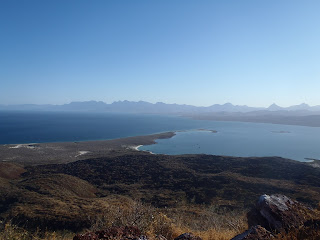
View from top of Isla Coronados
     I stopped in Loreto and spent an extra day there.  This was the location of the first successful settlement and Jesuit Mission by the Spanish and is as old a town as you can find in North America.  It was the last place for supplies before the 175 mile run to La Paz.  I had noticeably lost weight by the time I got there.  The first night I had 3 chicken enchiladas with rice and beans at one restaurant and then went and ate an entire family size pizza at another. 
     As I was packing up the boat to leave Loreto a damn Lab came up and started sniffing my gear.  I didn't think anything of it until he lifted his leg and claimed it as his own by pissing on it. At least everything was in dry bags so I could rinse it off.  That day got me to Puerto Escondido which is a great hurricane hole for boats and has a big marina.  It was there that I saw news of the Boston Marathon bombing.  This terrorist attack effected me more then many others since it was directed at my running brethren and I have no problem imagining me or Kathleen being there during the race.  The yacht club there had a big book exchange so I was able to get some new reading material.  The reason books are free in a book exchange is because they all suck.  Way to many murder mystery and romance novels.  I did manage to find a couple of books that worked though - a spy novel and a Revolutionary War historical fiction book. 
Baja Outdoor Activities guided group
     It was the next day of the trip (Day 40) that I saw my first kayakers go by.  I was fishing at the time so didn't have my camera to catch the moment I had been waiting weeks for.  I got up early the next morning to catch up with them and took their picture.  It was a group of 8 clients (including a 77 year old woman)  with one guide from BOA (Baja Outdoor Activities) doing a shorter version of the Loreto to La Paz paddle.  We chatted and the guide warned me that a north wind was supposed to blow for the next two or three days.  That worked for me since I had planned on taking a rest day at a village called Agua Verde.  There is a goat farm and small store there.  The second day I got a little antsy and paddled 10 miles despite the big waves.
Goats herded through camp - Agua Verde
     The next day I met the other group of kayakers that I would see on the trip.  2 couples in 2 tandems.  Janet and Pat have a ton of experience and reminded me of an older version of Kathleen and myself.  The other couple were Greg and Louisa who haven't kayaked but have traveled a lot.  Each morning I would pass their camping spot and they would invite me to shore for coffee.  They would then go past me in the afternoon and camp a little ways further down the coast.  We leap frogged like this for several days.  We would talk kayaking, traveling, and just general adventure.  I even camped with them one night after a town called San Evaristo. 
Pat and Janet

Sunset behind Cerro Caballo
     The next morning I had another example of how great the Mexican people are.  Pat left his wallet at the Tienda (store) the day before.  The owner had checked with all the sailboats anchored in the harbor and then sent fishermen in a panga down the coast to catch the kayakers.  The fishermen gave Pat a ride back to town and he was able to recover his wallet intact. 
     The last days the coastline gradually flattened out into low bluffs and then a very large sandbar that formed Peninsula el Mogote that creates the La Paz harbor.  I saw more turtles in this section then anywhere else and on the last day a new type of vibrant blue jellyfish I hadn't seen before. 
Last bluffs of coastline

Blue jellyfish
     The last night I stopped 2 miles short of the finish line so that I could stare across the harbor of La Paz and reflect on the trip I had just accomplished.  It was weird to be so happy and sad at the same time.  I stayed up late looking at the lights of La Paz (I hadn't seen that much electricity since Los Angeles, CA) and listening to the sounds of music drifting over the water.  With a very large moon rising over it all it seemed as if the last two months were a dream. 
   
View across harbor at La Paz
     The next morning I paddled across the mouth of the harbor to the Hotel La Concha where my Mom was supposed to have checked in the night before.  There was no sign of her when I arrived and the front desk said she was a no show the night before.  Since I had no email or Facebook message from her or anyone I figured she had airplane connection issues.  I sat down at the bar and 3 beers later she showed up after spending the night in the Mexico City airport.  We hung out for a few days in La Paz before I flew back to LA to meet Kathleen, get my truck, and road trip back down to La Paz.  My Mom stayed in La Paz to watch my kayak and gear until I got back.
Just finished - La Concha Hotel
    The trip that I had dreamed of doing for so long was done.  I don't ever need to repeat that paddle but I absolutely would come back down here with friends and do some 10 day or 2 week paddles out to some of the islands I passed.  I never felt unsafe in Baja at all or met anyone else who had any problems.  I can't speak for mainland Mexico but I would recommend coming here to anyone.  Many of the people I met here are in their 60s and 70s driving their RVs.  If they can travel here then my younger outdoor friends should have no problems at all.   

Final Tally:  51 days, 730 miles paddled, 553 miles as the crow flies from San Felipe