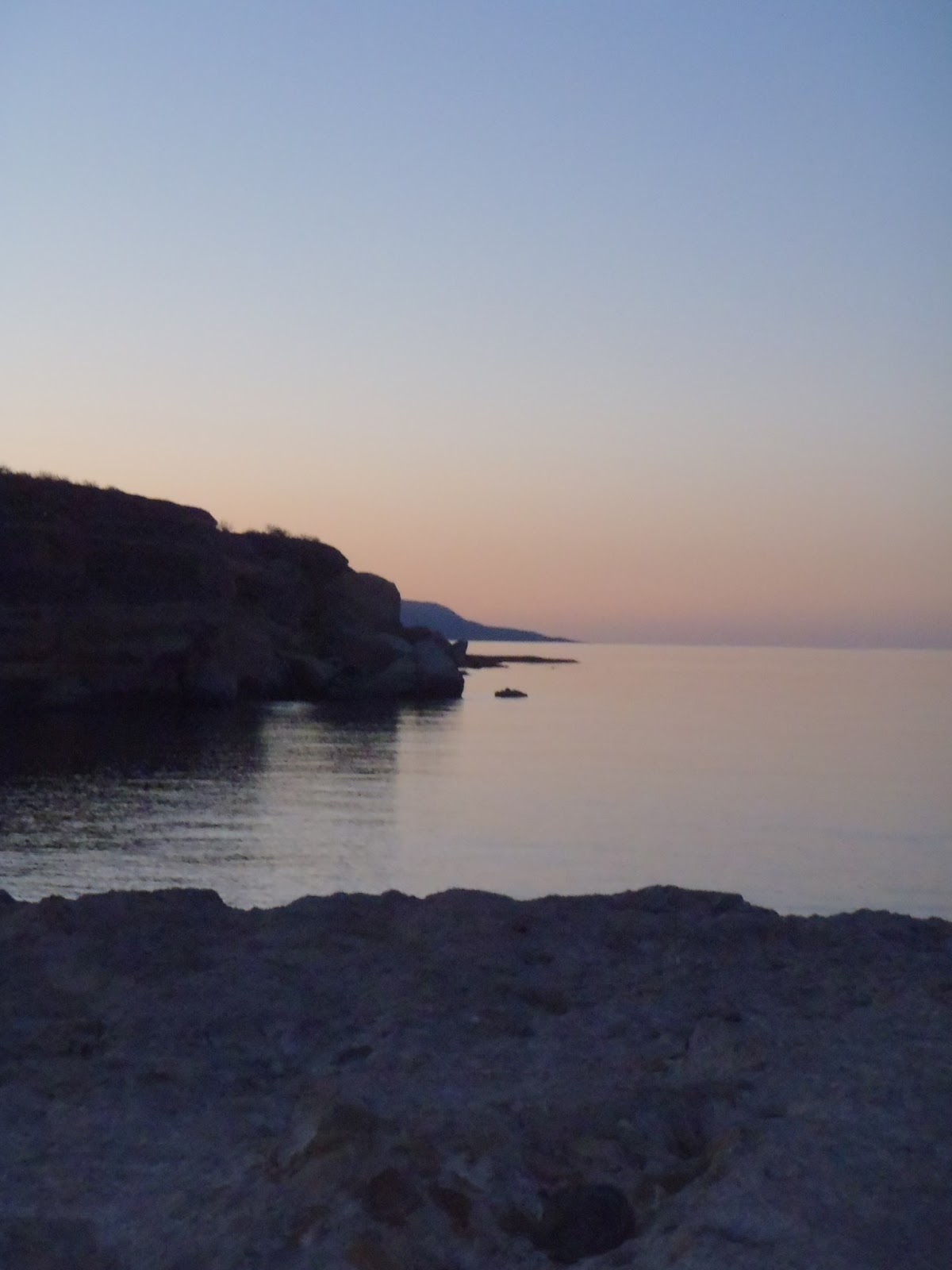
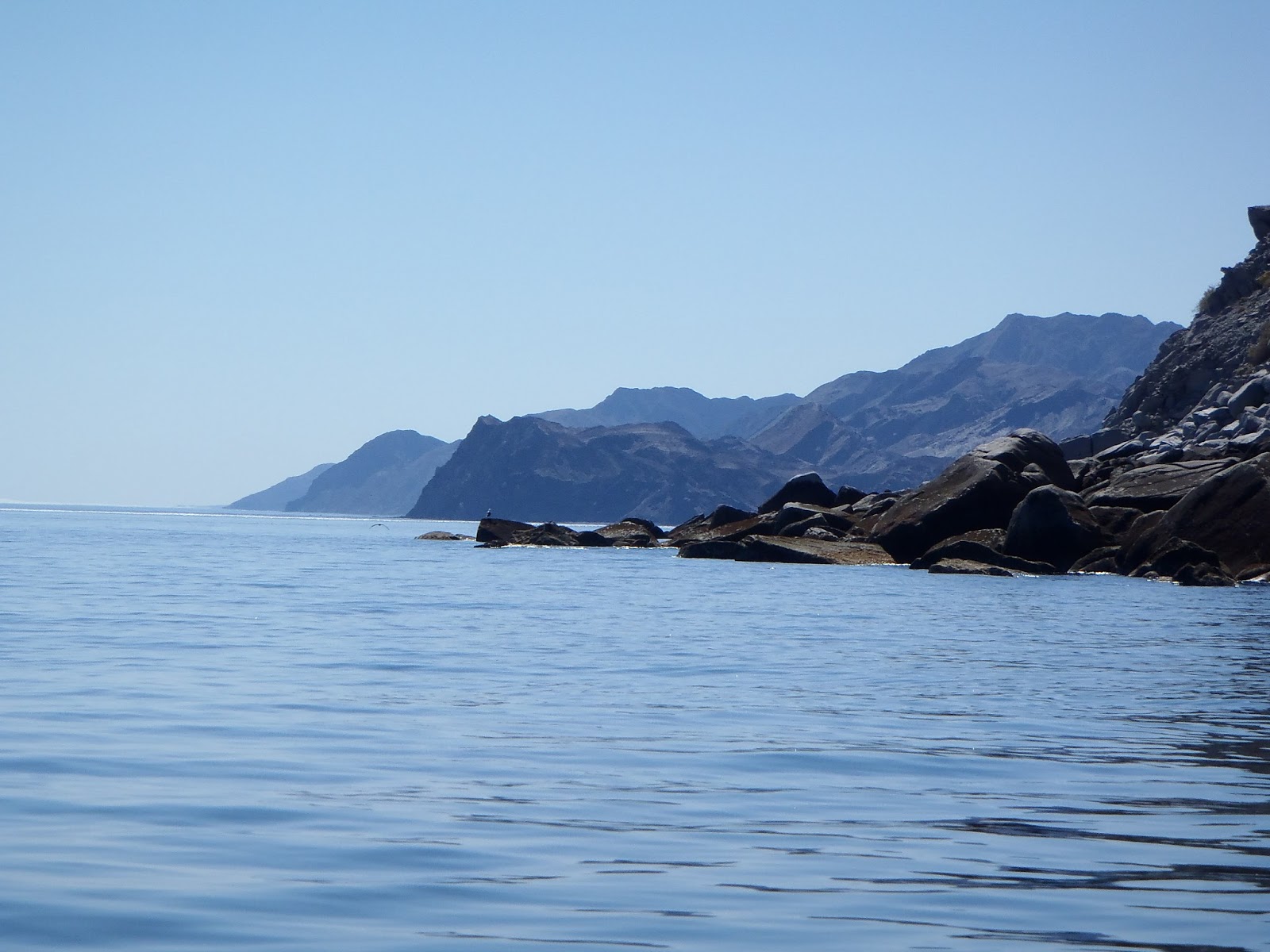
After reaching Bahia de Los Angeles it was time for the meat and potatoes section of the paddle where I started to feel the grind. The excitement of the first two weeks had worn off and the realization of how far I still had left was starting to sink in. The other thing I learned quickly in this section was that the information I had gotten off the Internet was wrong and that I had 40 miles further to go then I had thought initially. Between these two facts and some rough wind/wave conditions coming around Punta las Animas two days out of LA bay put me in a bit of a mental funk for Week 3.
The coastline in this section was a staircase down a series of bays. I would go south for a bit but then would have to go to the east and sometimes a little bit north again before I could get to the next section of dropping south again. The wind conditions would determine whether I would shortcut across the bay sometimes up to 2 miles off shore or if I would take the long way around and stick closer to shore.
I started passing larger fish camps where the fishermen spend part of the year chasing the fish. Life looks rough here. No electricity or running water. Basically they were shanties of scrap wood and tarps. Sometimes there is part of a camper, RV, or truck incorporated into the structure. The fishermen do have houses in town and are only in these camps for part of the year. They work in open boats that reminded me of the type of lifeboats you see in movies for the Titanic. Some of them look like they are not far from sinking.
Two days into this section I had my first real rough day on the water. If you get water swamping into the cockpit at launch it is a good sign that you are in for a rough ride that day. Big waves were reflecting off the cliffs making clapotis or "washing machine water". Confused seas with white caps and no rhythm or pattern to the water. I was not happy with the situation I found myself in as I traveled around Punta las Animas. It didn't go knucklehead on me but I kept getting hit by waves and was pretty wet. I was in a bit of a bad mood for several days after this. I had told people I wouldn't take risks and felt like I had pushed it when I shouldn't have.
When I reached the village of San Francisquito I saw further evidence of the hard times Baja is on between the economy collapsing a few years ago and the decreased tourism from the bad media about the drug war. Many restaurants and stores are closed due to lack of business. In San Francisquito it was somewhere in between. Part of the resort there had collapsed in an earthquake the year before but the kitchen was operating so I was able to get food, beer, and they even had Wifi when the generator was running. This ended up being a cool night of entertainment. As I screwed around on my phone checking emails and Facebook, the locals gathered for a night of drinking beer, playing guitar, and singing.
It was in this third week that I started feeling the cumulative effect on my body of paddling approximately 17 miles a day. I would crash hard in the afternoon when I would take a siesta and my rib cage muscles were really sore. I had to start balancing going long distance on days when the wind was calm versus the sustainability of being able to paddle day after day. I was trying to avoid the red zone while still making up the extra 40 miles that this section unexpectedly had.
This became the time of the full moon. It was one of the brightest moons I have ever seen. You could hike through the desert without a flashlight. I saw evidence of coyotes at almost every beach I stopped at. At night I would hear them yip and yowl, often very close to my tent. Between the bright light and all the noise it was amazing I was able to get any sleep. When I had first started the trip it had been the new moon. Without any electricity being used nearby it was the opposite at the start. It would be so dark at night that you could see an amazing amount of stars. I did notice that the North Star and the Big Dipper were lower on the horizon then I was used to since I was so far south. The entire trip lasted two full lunar cycles - 2 new moons and 2 full moons. This meant that the tide cycle also changed. Some weeks the tide was helping me but this was a week where the currents were running against me.
The landscape started to change some. I began to see palm trees and these were to become more numerous the further south I went. I continued to see whales but they were never that close. The loudness of their blowholes would alert me to their presence from a long distance off. I saw a 2 mile long parade of over a 100 dolphins all leaping out of the water at the same time. I started to see crabs on the shoreline. Turtles also began appearing but I would only see their heads. They were very shy and as soon as they saw me they would dive away. It was also in this section that I passed Isla Tortuga. I decided this must be the island from the TV show "Lost". It looked similar and seemed to be floating along with me. For days I would look to my left and it would be there, never moving. It also seemed to be creating a vortex of strong current against me.
I started having some success trolling a line behind my kayak to catch some fish for lunch. It is delicious when you can catch it, go straight to shore, and fry it up in some oil with some salt, Cajun seasoning, or garlic. It would be so fresh that the muscles would still have energy in them and try to curl and move away from the heat. Pretty much if you drag something shiny that wiggles through the water then you could catch something, especially in shallow rocky water. Silver spoon lures worked great. I didn't have a fish guide but I think I caught sand bass, trigger fish, and barracuda. The one thing I would do different "next time" would be to use a heavier test fishing line. The 15 pound test didn't cut it and I lost a lot of lures when the fish would first strike.
My mood improved as I neared Santa Rosalia. The weather/winds had gotten better, I had some nice camping spots, I realized that I wasn't going to run out of water, and I started to hit some milestones. I crossed from Baja Norte into Baja Sur and changed to the Mountain Time Zone. I also passed the halfway point a couple of days before I reached Santa Rosalia. Santa Rosalia was where I could start looking forward toward the finish instead of looking over my shoulder to see how far I had come.
Santa Rosalia was the best day of the trip. I went to the marina first where I was able to get a nice Canadian couple Russ and Gwen of the sailboat A-Train to watch my boat and gear while I ran into town. I didn't realize it until I got there that Oh Shit! it was Easter which is a huge holiday in Mexico. I met a guy in town who helped my find the supplies that I needed. Turns out that he was not from the town because he had just been deported from all places, Tacoma, Washington. Since he didn't know where anything was he just kept asking every pretty girl he came across where things were and his system seemed to work. I was able to restock on food and water, get a real meal and some cold beer, and found a WiFi connection so I could contact Kathleen and the rest of the world. It was a beautiful warm day with very calm water. I paddled out of town about 3 miles to Morro el Fraile which my research had told me was a place to camp. What it didn't say was that it was one of the coolest camping spots in the world.
I camped on a flat sandstone ledge with shells and fossils visible throughout the rock. I would jump off of the ledge and there was great snorkeling around it. From the rock there was a 270 degree view of the flat super blue water with several islands offshore and light yellow sandstone bluffs continuing to the south. The calm water created mirages where the land seemed to stretch between the islands and the mainland. Mexican families would come down to the beach and fish from the ledge by twirling weighted hooks and throwing them as far out in the water as they could.
A Mexican by the name of Javiar introduced himself. He was with his brother and their families. He caught some fish and then the wives made ceviche right there which they shared with me. The sunset that night was breathtaking since the water was so calm. The horizon turned dark topped by a layer of red and yellow. The clouds turned to various shades of crimson while the water took on a multicolored sheen that looked like when there is oil in a parking lot puddle but this was all natural. A swirl of purple, red, and yellow. I have never really seen water turn colors like this. I slept that night to the sounds of whales breathing as they passed by the ledge. One of the most magical outdoor experiences of my life.
From Santa Rosalia it was a three day paddle down to Bahia Concepcion. There were small towns along the way. I also began to see other types of boats besides pangas and Navy gunboats. I started to see lots of sailboats and some commercial fishing trawlers. The first day out of Santa Rosalia I was driven to shore early by the wind. The best place to stop was next to a house. When I went and asked if it was OK to camp they said (In Spanish), "No problem, and do you want some food and beer?". Turns out that they had a little clam shack restaurant so I got to eat well that night.
The next day I arrived in Punta Chivato which I have been calling the Beverly Hills of Baja. It is a rich American community. I stopped at the first house on Shell Beach which is so named due to the thick layer of shells on it. There I asked the owner, Russ Blackman, if there was someplace where I could find a restaurant, cold beer, and Internet. He replied that there was no restaurant but that he had plenty of cold beer and Internet. Once again the Baja Way blew me away. We hung out all day until after dark. He even found some white gas for my stove from one of his neighbors. He had been there for 30 years so he was able to fill me in on the changes that had occurred there over the years. He had all sorts of information from the history, to wildlife and fishing, and the local gossip.
From Punta Chivato south for the rest of the trip the amount of seabird life dramatically decreased. I have to guess that this had something to do with the increase in commercial fishing that I saw. Russ said that they even use helicopters to spot the schools of fish. The amount of stingrays in the water here and continuing into Bahia Concepcion was impressive and a little scary. I definitely shuffled my feet when I waded in the water to scare them away.
It was between Punta Chivato and Mulege that I saw a whale shark. I was short cutting across the bay instead of following the coastline and was about 1 1/2 to 2 miles off shore. Suddenly there was a double fin (a dorsal fin and a tail fin) sticking out of the water a short distance ahead of me. It spotted me and came over slowly doing Figure 8's around my boat. It was about 25 feet long and moved fairly slow but it did come within 6 inches with its tail and it would swim under me. I sat there for about 20 minutes watching it with my mouth hanging open in amazement. I knew they were in the Sea of Cortez but I never expected to see one. This days paddling got me to Mulege and the start of the southern section.
In Mulege I took my first full day off. My camp on the beach was literally next door to the El Patron bar. Mulege is a scenic town along a river estuary that has been hit hard by hurricanes twice in recent years (2006 and 2009 I think). It seems to be half Mexican and half American and had an international flavor to it. I met Mexicans, Americans, Canadians, Germans, and Belgians. Mulege confirmed to me that if you want to move to Baja then you need to love alcohol and fishing.
I had now been paddling for 27 days and had covered 422 miles.
Wednesday, May 8, 2013
Wednesday, May 1, 2013
Norte Cortez - the summary. Part 1 of 3
20 years ago I read a book called Wind Water Sun by Ed Darack that had incredible color photography and was about his solo kayak journey down the Sea of Cortez. As soon as I read the book I said that I wanted to do that even though I had never sea kayaked at that point. After 20 years of talking about it, training for it, and trying to get my act together to do it twice before I finally had everything fall into place and was able to do it. The following is a summary of the first third of the trip with some of the pictures from along the way.
I left Seattle with my kayaks on the roof of my truck and a ton of gear in the back on 28 Feb 13. I spent the first week slowly road tripping south visiting friends in Oregon and California eventually arriving at Home Base California in LA belonging to my friends Juli and Morgan who let me leave my truck and a bunch of gear at their house while I was in Mexico.
Along the way I picked up Toby at LAX who was going to drive down to Mexico with me, drop me off, and then drive my truck back to Home Base California so it would be safe. I had never actually met Toby besides phone conversations. He is a Brit who was a friend of a friend from work they did in Kenya that got connected to me through Facebook. Toby like me has this drive and need for adventure. He once rode a motorcycle by himself from Nepal back to England and then a year or two later rode a different motorcycle around the coast of Africa from Egypt to South Africa and then back up to Morocco. Years ago he lived in Baja for a period of time. He is currently training to help try to get the first Kenyan woman to the top of Everest. He heard about my adventure and need for help, thought it sounded like fun, and volunteered to help. He turned out (as I knew he would be after talking to him on the phone for 5 minutes) to be a great guy and we had a lot of fun swapping stories. He and I drove into Mexico 2 days later and made it to San Felipe with absolutely no problems.
When we got to San Felipe it turned out it was race week for the Baja 250 so the town was full of dune buggies, sand rails, trophy trucks, motorcycles, ATVs, and even the cute little Volkswagon bugs outfitted for the desert. It was like a scene out of Mad Max/The Road Warrior with all the desert racing machines roaring around. We drove straight to the beach and I went and touched the Sea of Cortez for the first time.
We then went to get a beer. At the first bar we sat down I was instantly introduced to "the Baja Way" of sharing, being hospitable, and helping people out. The people at the table next to us turned out to be some Canadians (Louise, Mike, Ken, Carol, and their friend Lenny) who live down there part time. They heard about why we were down there, asked us where we were staying (we didn't know yet), and the next thing we know they invited us to camp out on their property. This then was upgraded to staying in their guesthouse once we got there.
Two days later it was time for me to launch off on this expedition. That morning I had questions of resolve and spirit. Would I be strong enough and determined enough to pull this off? I know from previous solo efforts that at times your brain is your own worst enemy. There was also a series of ominous omens that had me a little freaked out that morning. To start, when we woke up it was raining. It rarely rains here except during hurricane season. I figured it was the desert and that it would stop by the time we got to the beach and that turned out to be the case. The next bad omen was when we were taking the boat off the roof of the truck. Whenever I kayak or am on snow I always wear a pendant around my neck that is the Maori symbol for "Safe Passage Over Water". As we lifted they kayak the back end swung around hitting me on the chest smashing the pendant into multiple pieces. I am a bit superstitious so the fact that I broke the pendant with the kayak itself just as I was about to start this adventure was unnerving. I had a fleeting thought that I shouldn't go but I was way past the point of no return so loaded up the boat anyway. Then as I am about to start Toby asks "Do you have everything like your passport?". Oh shit!!!! My money belt and passport were stashed under the seat in the truck still. I had almost left without them. I really was nervous about starting. It just seemed like too many things were going wrong that morning. But nevertheless, I pushed the kayak into the water, pointed it south, and left Toby behind on the beach.
It didn't take long that first day before I started experiencing the various winds that Baja can throw at you. That day I learned that if you start seeing a dust storm brewing in the desert then get to shore as fast as you can. The westerlies are some of the strongest winds here and have blown kayakers out to sea. Luckily when it hit I was only a few hundred meters off shore and was able to paddle it in. It was cold that night. I had to stay completely bundled up in my 32 degree rated sleeping bag. In the morning when I started paddling the mountains were covered in snow. I never expected to see snow when I was down here.
The first 4 days to Puertocitos was a good warm up section. It was a sandy beach so I could land anywhere with a road following the coast so there were plenty of houses along the way. It was a safe section of coast to get a feel for the wind, waves, and how the boat was going to handle with such a heavy load. The landscape consisted of a series of low points that I would have to paddle around. The waves were always more intense at these points as the water tended to be shallower with a stronger current. The mountains were set back a distance from the coast. The rock and mountains would range from red to black with multiple shades of brown all jumbled into a confused geologic mess of uplifted strata with veins of different rock within rock, obvious old lava flows, and large arroyos (dry river beds) cutting through the hills periodically. The arroyos showed that for such a dry landscape that when it does rain HUGE amounts of water flows over the land. There was not much vegetation on the hills and what there was consisted of scrub brush, very small trees, and a variety of cactus. The cactus was predominately cardon (looks like saguaro but bigger), cholla, and nopal (prickly pear). The bird life was prolific. Huge flocks of brown pelicans, sea gulls, cormorants, boobies, terns, and frigate birds. They would often dive into the water all around me catching or attempting to catch fish. I also saw sea lions basking on the beach and in the morning I could see the green eyes of coyotes reflecting in my headlamp.
Every morning I would get up before dawn so that I could start paddling as soon as the sun came up. The winds tended to be calm first thing in the morning but by 9 or 10am they would start up. Those early morning hours were often the nicest paddling of the day. The other hurdle of this section of coast is the huge tidal exchange. There was a 20 foot difference between high and low tide. At times it can be even bigger then that. With the tide cycle where it was I was landing in the afternoon at high tide but it would be low tide when I launched. That meant I had to drag my kayak and gear sometimes an extra 1/4 mile to reach the water line compared to where it had been when I got to that camp the day before.
The highlight of Puertocitos was soaking in the hot springs, the "library and post office", and I met some Americans (Rob, Mike, and their sons) who have a house there. They invited me over that night for dinner and beer. They are lettuce/alfalfa farmers in Yuma, AZ but spend as much time as they can in Baja fishing. Puertocitos was otherwise pretty rundown and looked like it had seen better days as did most of Baja.
The next section to Gonzaga Bay was similar to the first part but became more remote. It was also some of the calmest water I saw during the entire trip and it is where I saw my first whales and dolphins. This section passes through an area called the Enchanted Islands. Each island in this area has a distinctly different color, size, and seems geologically distinct. It was here that you find if an island is white it is because it is covered with a frosting of bird guano. It also means that island smells bad.
It turned out that when the water was that calm and flat that I had problems. If there is turbulence in the water I can see where the underwater rocks are. This section is where I hit my first submerged rock. It also created a phenomena where the water was so smooth that I would lose my depth perception with it. My brain would suddenly tell me that I was on a slope of water into a pit and I would get vertigo. I would have to quickly look to the land horizon to reestablish my stability and I almost capsized a couple of times because of this. I learned not to stare at the water too hard.
The next section was the part of the trip that had kept me awake at night worrying about it. It was a 60 mile section from Punta Final to Punta Remedios nicknamed "The Wall". For most of this section the cliffs come straight down into the water with few beaches to land on. It was the most technical section of the trip and a bad place to get caught if the winds picked up. While I passed through this the winds tended as usual to be calm in the morning and then pick up in the afternoon. I managed to get through this area without any problems besides being nervous and having anxiety dreams at night that involved snow and avalanches. It however was also on this section that the first of several nights occurred that I could hear whales breathing as I lay sleeping in my tent. The other wildlife highlight was when sea lions were coming up out of the water and grabbing these cute little grebe seabirds right in front of my kayak for about a 5 minute period of time. National Geographic kind of stuff happening right in front of me.
"The Wall" was the most remote section of the entire coastline and I did not expect to see anyone along here. One day in the middle of the afternoon I was laying in my tent when I heard a different sounding engine noise. At first I thought it was a plane but then it was too close. I stuck my head out of the tent to see what it was and to my surprise found a Mexican Navy jetboat/gunboat, the "Albiereo", coming around the corner. I figured I should wave and say Hi. They obviously weren't expecting to see anyone either because as soon as they saw me multiple guys started running around and coming out of the bridge. They instantly turned the boat and brought it in as close inshore as they could which was about 30 yards away. They then questioned me on who I was and why was I there. I explained that I was a solo kayaker traveling from San Felipe to La Paz. That seemed to flabbergast them and I had to tell them 3 different times that there was "no problema". They finally seemed satisfied and moved on after a bit.
After getting through "The Wall" that got me to Bahia de Los Angeles which ended the northern section of the trip. LA Bay is known as the poor mans Galapagos. It is a bunch of small islands where similar natural selection has occurred as did on the Galapagos. Animals only miles away from each other have distinct species differences. There are species of plant and lizard here that are found nowhere else. It is also a lot easier and cheaper to get to then the Galapagos. I camped on Isla Ventana before going into town to get food, beer, and supplies. On Isla Ventana I was treated to a dolphin show right outside my tent that was like something straight out of Sea World. Dolphins doing front flips in pairs, back flips, tail pirouettes, and just general dolphin shenanigans. The hiking on the island was pretty scenic also.
When I got to LA Bay my rib cage muscles ached more then anything and my hands had a few minor blisters but I was otherwise holding up. I had covered 191 miles in 13 days.
Monday, April 29, 2013
Blog for the gear heads
Only the true gear heads may be interested in this one. The following is the gear that I used and a little bit of what worked, what didn't, and what I might do differently if I was to do it again.
Gear Used:
- Perception Eclipse Kayak. 17', polypropylene with a rudder - I love this boat. Can't say enough good things about it. She carried a ton of gear, tracks nice and straight, and never thought about capsizing on me even in the biggest wave conditions I have ever paddled.
- Werner straight handle paddle with a really heavy Perception paddle as a back up. Thankfully I never have needed the back up paddle because it would destroy my shoulders within an hour.
- Nylon Eddyline spray skirt
- Stohlquist Tow Motion PFD
- Whistle and Flint/steel kept within PFD
- Paddlefloat, pump, and a 50' rope throwbag. The throwbag turned out to be useful as quick access to line to land when the surf was trying to drag the fully loaded boat back out to sea or to tie up to sailboats.
- Orion Skyblazer II Flares x8
- Both a deck mounted and a hand held compass
- ACR Aquafix 406 EPIRB - float plan was preregistered with NOAA so if it went off they would know that the distress signal was real.
- SPOT Connect - so I could send daily position report to friends and family. Also functioned as a back up distress beacon.
- ACR Firefly3 SOLAS Strobe Light
- Cockpit Cover - for keeping the creepy crawlies out of the cockpit at night. No scorpions, roaches, mice, snakes, bees, or spiders please.
- Mountain Surf Paddle Jacket - I would not bring this next time. The water is fairly warm and any time I was getting wet enough to need it the adrenaline and effort were keeping me warm.
- Marmot Aura 2P tent - I don't think I would use this for this kind of trip again. It didn't shed the wind very well. I both snapped one of the guy lines and had the fly rip in a small spot. Also since the body of the tent is mesh is allowed the fine grit sand in when it was blowing. This is the kind of sand that is especially hell on electronics and camera/sunglass lenses.
- Mountain Hardware Phantom 32 sleeping bag - it got cold at night sometimes. I wouldn't have wanted any lighter of a bag.
- An old 3/4 length Ultralite blowup Thermarest
- 1 wide brimmed hat, 1 baseball cap, and 1 keffiyeh
- 2 bathing suits
- 2 paddle shirts - one short sleeve and one long. I only ever wore the short sleeve one. It is now pretty much destroyed. Should have brought two.
- 1 pair of Tevas - the sand and straps tore up my ankles
- 1 pair of Mountain Masochist trail running shoe - the lava rock tore these up pretty quick though they did already have a bunch of miles on them.
- 3 bandannas - there are at least 101 uses for these things
- Microfiber towel
- Beach towel - initially I thought this was silly but it worked great to lay on or fold up to pad my bony butt in the kayak or when sitting on rocks. Really glad I brought it.
- A bottle of camp soap and a bottle of waterless shampoo
- MSR Whisperlite International Camping Stove with 4 fuel bottles of various sizes
- Camping mess kit and a small teflon frying pan
- Whisperlite repair kit, Patch kit for Thermarest, Sewing kit, 2 spare rudder cables (ended up needing one), and an extra foot peg.
- 10L MSR Dromadory Water Bagsx4 (usually only used 3) and 4 x 1L Nalgene bottles - basically an 11 to 12 day supply of water.
- Garmin eTrex 30 GPS
- IPhone 4 with DriSuit waterproof case
- Olympus Tough TG-810 Camera
- GoPro Hero3 Camera
- IPod Classic
- Seattle Sports SUB HandCrank Flashlight with laser and ability to charge IPod
- SOLIO Magnesium Solar Charger
- Small pair Leica 10x25 binoculars
- Petzl Myo XP headlamp - batteries last forever in this thing. Nice and bright when the batteries are new.
- Only used 9 AA batteries between the headlamp and the GPS
- First aid kit with signal mirror
- Julbo glacier goggles. I also had a pair of Foster Grant Ironman sunglasses but they died the first week.
- Assortment of dry bags - various sizes and companies.
- SEAL Line Baja Deck bag - also worked great as a "purse" when going to town'
- 2 tubes of SPF 50 sunscreen and Chapstick
- A big mesh bag for carrying all the little bags and assortment of stuff when loading and unloading boat.
- Books and harmonica for entertainment
- Collapsible fishing pole with a selection of lures. Spoon lures tended to work the best.
The two things that I would do different next time would be: 1) I would have brought some body glide. I did have some chaffing issues from my PFD around my "love handles". 2) I had 15 pound test fishing line on my rod and it would often snap on the initial strike. Lost a bunch of lures that way. 25 pound test would have been better.
I am sure there are a few other little things I had but this is the bulk of the important stuff. For the most part it worked out fine. The sun, sand, and salt are hard on stuff. All my pants ripped out except for one pair and that only survived because I stopped wearing them after I realized it was my last intact pair. My "waterproof" wristwatch/altimeter also went haywire within the first few days.
Sunday, April 28, 2013
SUCCESS!!!!! If I met you inBaja then read this! A BIG THANK YOU!
So I have made it to La Paz. The trip was a great success. I'm a little blistered, chafed, cut up, and bug bitten but the trip never truly went knucklehead on me. My plan is to do a longer writeup of the trip in 3 parts (Norte Cortez, The Middriff, and Baja Sur) and to post some of the best pictures. This will take some days to get done. In the meantime while people are still fresh in my memory I wanted to single some people out for helping make my trip a resounding success. The people I met made the trip even more spectacular.
First I want to thank my parents. Teaching me to ski before I can even remember and traveling as much as we did gave me an early love of the outdoors and adventure. From these early roots comes the drive to do a trip like this and the other activities in my life that give me so much joy.
However, my biggest beef of this trip is also with my parents. What were you thinking when you let a 4th grader go see JAWS in the movie theatre alone when it first came out? That movie has messed with my head for my whole life and this trip was no different. Always waiting for a huge mouth to rise up out of the water from underneath me, especially when paddling early in the morning. Hell, even swimming pools used to make me nervous.
Just as big a thank you needs to go to Kathleen. Your love, support, and words of encouragement gave me more strength then you even know. I know it was hard for you for me to be gone and out of contact as much as I was. I am SOOOO looking forward to this next adventure stage that I get to share with you. Thank you for being my biggest fan and supporter.
Juli and Morgan Cavanaugh were a key component in the logistics of pulling this together. Their house (actually houses since they moved while I was paddling) was Home Base California. They have watched my truck while I was in Mexico and I have a bunch of gear and another kayak in their garage. They helped simplify the process of getting myself and my gear both into and out of Mexico. Plus they are a blast to hang out with and always have good wine.
The other person I could not have done this without would be Toby Storie-Pugh. Toby is a friend of a friend (and now a friend of mine) via Facebook and Kenya of all places. He has a crazy love of adventure. He heard about my trip and decided that without knowing me it sounded like fun to fly out, come help me drive into Mexico and then drive my truck back to Juli and Morgan's house. He turned out to be cool as shit and I hope to be able to have other adventures with him in the future. Without his help I am not sure how I would have gotten to the starting line with a 17' kayak and 200 pounds of gear.
GU Energy Labs also provided nutritional support for my expedition. I actually really like their flavors and the packets easily fit into my life vest. When I was tired in the afternoons, the wind was picking up, and I needed that extra energy to my muscles to keep me going (or to turn on the afterburners when it got rough) the GU shots provided it.
The following is a list of (hopefully) all of the people that showed me the Baja Way. I had several different people call it that. It meant sharing what you have, helping people out, and just generally being hospitable. So many people offered help, big and small, without solicitation. From the first bar that Toby and I sat down at in San Felipe to the final beach in La Paz. No one I met that lives or visits regularly here felt unsafe and the same applies for me. I would have no problem recommending to people to come visit Baja.
- Louise, Mike, Ken, and Carol - let Toby and I stay in their guest house in San Felipe in the middle of race week for the Baja 250. It was the last bed I slept on for almost 2 months.
- Rob, Mike, and the boys from Yuma - fed me a home cooked dinner in Puertocitos.
- Antonio at Alfonsina's - let me camp on his front porch for free.
- Dennis and Larry - gave me a ride from Alfonsina's to the market in Gonzaga Bay.
- Joe and his friend (sorry, I don't remember your name) - conversation and cold beer in San Francisquito.
- Russ & Gwen of S/V A-Train - watching my kayak so I could go into Santa Rosalia for supplies. This turned out to be the best/most incredible day of the trip and they started it out on the right note for me.
- Javiar & Marco Dominguez - sharing ceviche and their Easter Sunday with me and tolerating my horrible Spanish.
- Russ Blackman in Punta Chavato - a great help. The perfect beach to have washed up on that day. Beer (and a lot of it), internet, electricity to charge cameras/phone, finding me some white gas in the community, taking pictures, letting me camp on his property, and just great general conversation and hanging out.
- Dave - gave me a ride into town in Mulege.
- Kenny F - helping me find stuff that I needed around Mulege.
- Pete, Janeene, Allen, Cathy - beer and good times in Santispac
- Scott, Joy, and family - another great beach to have washed up on after the most intense paddling conditions of the trip. They let me camp on their beach and then fed me both a home cooked lunch and dinner.
- Jim & Diane of S/V Prairie Oyster - coffee on their boat at Punta el Pulpito. Spectacular scenic day.
- Brian & Elizabeth of S/V Autumn Wind - cold beer on Isla Coronados.
- Bob and Mike - letting me stay at Loreto Shores and cutting me a deal.
- Danny & Jane - cold beer and a ride into town in Loreto.
- Christian of BOA (Baja Outdoor Activities) - coffee cake.
- Jim in Agua Verde - gave me the fishing lure "that never fails".
- Janet & Pat from Telluride (an older version of me and Kathleen) - coffee, blue cheese, and for letting a lonely kayaker hang out with them for entertainment and travel/adventure conversation.
- Louisa & Greg - Vegy stir fry
- Andrew of S/V Del Mar - gave me his last beer for celebrating getting to the finish line.
All the help and interactions I had with you (and others) made an incredible trip even more special. Thank you. Some of you don't have my blog address or even computers but I still wanted to send you a shout out for being you and to show people how incredible this part of the world is.
Sunday, April 14, 2013
A Rough Week
Since I left Santa Rosalia the landscape has become even more amazing however the conditions this week have been less then friendly. Bahia Conception was sheltered, mellow, and a great place for novice paddlers. However once I left the bay and headed around the peninsula that forms it the North winds started to blow and kicked up a swell. This is also the second most remote stretch of coast on this trip. Nobody goes there in boats because there are no anchorages. The first day wasn't too bad but by the end of the day the swells were building. It was the second day that I will remember for a long time. From camp that morning the water looked unsettled but better than the day before. Once I got out there I discovered that wasn't exactly true. That was also the morning pretty much at the start that I came across a pod of dolphins leaping out of the water. I started to fumble for my GoPro because they were close. It was then that I realized we were on a collision course. I figured they were dolphins and knew what they were doing but they did not notice me. Suddenly one leaped way out of the water and landed within 3 feet of me. I thought it was going to land on me and these things are big. At best I would have capsized, at worst it would have knocked me out. I started to scream at them to get their attention. Unfortunately, the GoPro just comes on as I yell "Don't land on me!" They finally noticed me and scattered. That was just the first adrenaline rush of the day. The swells coming from my left rear side kept getting bigger. My butt is basically at water level so when waves get 3 1/2 to 4 feet tall they start blocking my view of the horizon when I am in the trough. These swells were blocking my entire view of the mountains. I thought they were about 6 to 7 feet tall. A sailor I talked to later said 8. By far the biggest waves I have ever paddled in. Not the roughest water (that would have been in Deception Pass in WA) but the tallest. The swells weren't breaking which made all the difference in the world. The problem was the wind kicked up and started making wind waves that were hitting me from the right side. I would surf down a swell which would then cause me to hit a wind wave and throw up a big spray of water into my face. I did notice that this is a lot less frightening when the water is bathtub warm as opposed to the ice cold, 20 min survival time water of Washington. I wanted to get to shore but these same swells were creating a huge surf that looked even scarier then what I was in so I continued. I knew (thought I knew/hoped) that once I got to a certain point that the coast turned south and that should protect me from the swells at least. That was the case and from then on it was a 2 hour grind against a headwind to get to the cove I knew would provide protection. I expected a fish camp but when I got there it is all private property. Luckily the first person I talked to was Scott who was the caretakers son. He took one look at me and said "We can't send you back out there". I looked a little ragged and worn out. He showed me where I could set up camp and then his family proceeded to feed me both lunch and dinner. Once again the "Baja Way" of sharing what you have was shown to me.
The next two days were windy and rough also. Wet rides each day but nothing of the magnitude of the second day. Other nice people helped. I was invited for coffee on a sailboat anchored under Punta el Pulpito which is one of the most stunning pieces of rock I have seen yet. I paddled through an arch/sea cave. The sailboat was S/V Prairie Oyster with 2 Canadians Jim and Diane. Turns out that they had sailed the South Pacific and had never met my friends Shawn and Ben but they had totally heard of their boat S/V Pangea since it was during the same years (2008 I think). Small world.
Still waiting to run into another kayaker. I did see some people in day paddlers in Conception Bay fishing from them but no true touring kayaks. I still get the same thing from everyone that hears what I am doing. The Mexicans think I am either crazy or very strong. From the gringos I either get "Hardcore" which translates as "I would like to do something like that" or " Ballsy" which from the tone of voice translates as "You're an idiot". I think they are all right.
Yesterday I found swarms of bees where I had planned on camping so paddled an extra couple of miles out to Isla Coronados. Much prettier campsite but there they had a rattlesnake relocation program going on. It's been that kind of week.
The trip continues to be really rough on gear. My tent is ripped, my bathing suit is ripped, both sneakers are blowing out, and my paddle shirt can stand up by itself. It may just spontaneously combust. I may show up in La Paz half naked with nothing but my kayak and a paddle.
Homestretch. 2 weeks to go. A person can only read, write, nap, and play harmonica so much before he starts to get bored. More then ready to go adventure with Kathleen. When I hiked the Colorado Trail it was a longer trip but there were people on the trail to talk to pretty much every day and I had friends do parts if it with me (and my dogs). Here it is remote and I can go days without talking to anyone. Gets lonely. Plus I just don't like being separated from Kathleen for this long. At least she and I are about to have one hell of an adventure together.
Thursday, April 4, 2013
A Day In The Life Of Fid
For those of you who are interested, the following is a description of my life right now.
The alarm is set for 5:30am which is better then the 4:30 it was when I was still in the Pacific time zone. Either way, it is still totally dark when I wake up. This gives me time to pack up my gear, make breakfast and a mug of coffee (I "borrowed" Kathleen's camping French Press), drag the boat and gear down to the edge of the water, and then to launch just as the sun is breaking the horizon. It is light enough to paddle before then but honest to God's truth I saw JAWS in 4th grade and it is still messing with my head. Twilight paddling freaks me out. It tends to be cold in the morning where I need my shell but as soon as the sun comes up it gets warm fast. I then paddle between 15 to 25 miles. The wind usually picks up midday which is why I start so early. Sometimes that means by 9am and sometimes it never occurs (rarely). That usually determines how far I paddle that day. Sometimes I will troll a fishing line behind the boat if I feel like dealing with cleaning and cooking a fish. Pretty much if you drag something shiny that wiggles behind you then there is a fish that will come and try to eat it. By 11am to 2 pm I have reached my goal or am driven ashore by the wind. I then unload everything and set up camp. By then I am hot and sweaty so I will often jump onto the ocean to cool off. Then it is time to eat my lunch (usually a peanut butter and jelly tortilla), send out a SPOT signal to the world to tell everyone I am alive, figure out the next days paddle on the charts, and then take a siesta on the shady side of my tent through the hottest part of the day. Around 4:30 or 5pm I will go walk into the desert to see what I can find for a bit. Then it is time to make dinner and shortly after it is dark I go to sleep. Somewhere during the course of the afternoon I will journal the days events also. Survival takes a lot of time. I really haven't had as much time to read as I thought I might. I also have my harmonica to keep me occupied. It is a simple but very fulfilling existence.
Mulege - Gateway to Bahia Concepcion
In Mulege. Gateway to Bahia Concepcion, Mecca for paddling in Baja. That said I have gone 420 miles and 27 days without seeing another kayaker. I have seen some little sit on top day paddlers on people's beaches but no one actually paddling. If I don't see someone this week I may go the entire way without crossing paths with one. I am finally taking a full rest day. I have had some half days but never a full rest day and the weather has really cooperated so I haven't had to take a weather day either. Basically I am 2/3 done and it is time to dump out all my dry bags and reinventory what I have left. I can resupply here and in Loreto in about 8 days. I am going to head from here into Conception Bay and have some mellow days there. There is a hot springs I want to find and some little islands that are an easy day paddle. About 19 days left. Still a chunk to go but the end is in sight at the same time. It is becoming more tropical now. The water is becoming noticeably warmer. Palm trees have started to appear. The types of fish are changing. My kayak keeps scaring up flying fish and I have seen sting rays by the hundreds. Whales still make occasional appearances. I had a 25 foot whale shark circling within feet of my boat, and the views under the water when it is calm continues to be amazing. This area has been commercially fished pretty hard (both legal and illegally) and that shows in the much lower density of sea birds here.
Mulege has an international flavor. So far I have met Mexicans, Americans, Canadians, Germans, and a Belgian. There is a pretty big expat community that lives here and it is easy to get to on the highway. Once again everyone I meet wants to take care of me. Give me rides, show me around town, help me find stuff, give me supplies, etc. Not one person who lives down here feels unsafe. If you are looking for some sun and sand I would highly recommend coming to Baja. It has been a fantastic place to visit.
Subscribe to:
Posts (Atom)